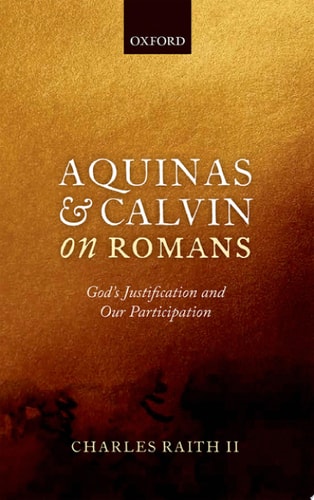
Aquinas and Calvin on Romans: God's Justification and Our Participation
0
0
As an Amazon Associate and affiliate partner, Menrva Books earns from qualifying purchases. Learn more
Author Description
Aquinas and Calvin on Romans is a comparative study of John Calvin's and Thomas Aquinas's commentaries on the first eight chapters of Paul's letter to the Romans. Focusing on the role of human participation in God's work of salvation, Charles Raith argues that Calvin's critiques of the "schoolmen" arising from his reading of Romans fail to find a target in Aquinas's theology while Calvin's principal positive affirmations are embraced by Aquinas as well. Aquinas upholds many fundamental insights that Calvin would later also obtain in his reading of Romans, such as justification sola fide non merito (by faith alone and not by merit), the centrality of Christ for salvation, the ongoing imperfection of the sanctified life, the work of the Spirit guiding the believer along the path of sanctification, and the assurance of salvation that one obtains through the indwelling of the Spirit, to name only a few. Even more, numerous identical interpretations arising in their commentaries makes it necessary to consider Calvin's reading of Romans as appropriating a tradition of interpretation that includes Aquinas. At the same time, the nonparticipatory dimensions of Calvin's reading of Romans becomes clear when set beside Aquinas's reading, and these nonparticipatory dimensions create difficulties for Calvin's interpretation, especially on Romans 8, that are not present in Aquinas's account. Raith therefore suggests how Calvin's reading of Romans, especially as it pertains to justification and merit, should be augmented by the participatory framework reflected in Aquinas's interpretation. The book concludes by revisiting Calvin's criticisms of the Council of Trent in light of these suggestions.
Menrva's Summary
THE THESIS
This study investigates the theological intersection between Thomas Aquinas and John Calvin regarding their interpretations of Paul's Epistle to the Romans, specifically focusing on the concepts of justification and human participation in salvation. Charles Raith II, a scholar of historical theology, utilizes a comparative methodology to analyze the commentaries of both figures on the first eight chapters of Romans. He argues that Calvin's historical critiques of scholastic theology often miss the mark when applied to Aquinas, suggesting that the two thinkers share significant common ground that warrants a re-evaluation of their relationship.
THE SCOPE MAP
What You Will Find
- A comparative analysis of Aquinas and Calvin on Romans 1-8
- Examination of key doctrines including justification sola fide, the role of the Holy Spirit, and sanctification
- A critical assessment of Calvin's critique of the Council of Trent
Scope Limits
- The analysis is restricted to the first eight chapters of Romans
- The study does not provide a comprehensive overview of either theologian's entire corpus
THE AUTHORITY PERSPECTIVE
Scholars and theologians frequently cite this work as a significant contribution to ecumenical dialogue and the study of Reformation-era polemics. Experts highlight the text for its rigorous academic approach and its ability to challenge long-standing assumptions regarding the divide between Thomistic and Reformed traditions.
Page Count:
256
Publication Date:
2014-01-01
Publisher:
OUP Oxford
ISBN-10:
0191017930
ISBN-13:
9780191017933
Religion
Theology
Biblical Commentary
Historical Theology
Community Tags
Similar Books