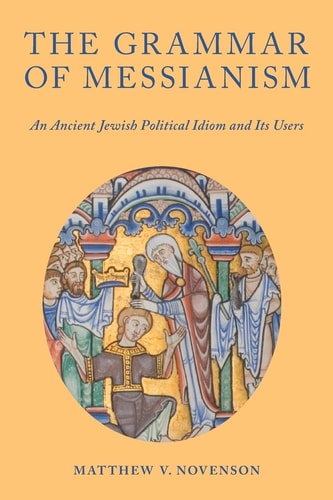
The Grammar of Messianism: An Ancient Jewish Political Idiom and Its Users
0
0
As an Amazon Associate and affiliate partner, Menrva Books earns from qualifying purchases. Learn more
Author Description
Messianism is one of the great themes in intellectual history. But because it has done so much important ideological work for the people who have written about it, the historical roots of the discourse have been obscured from view. What did it mean to talk about "messiahs" in the ancient world, before the idea of messianism became a philosophical juggernaut, dictating the terms for all subsequent discussion of the topic? In this book, Matthew V. Novenson offers a revisionist account of messianism in antiquity. He shows that, for the ancient Jews and Christians who used the term, a messiah was not an article of faith but a manner of speaking. It was a scriptural figure of speech, one among numerous others, useful for thinking about kinds of political order: present or future, real or ideal, monarchic or theocratic, dynastic or charismatic, and other variations besides. The early Christians famously seized upon the title "messiah" (in Greek, "Christ") for their founding hero and molded the sense of the term in certain ways; but, Novenson shows, this is just what all ancient messiah texts do, each in its own way. If we hope to understand the ancient texts about messiahs (from Deutero-Isaiah to the Parables of Enoch, from the Qumran Community Rule to the Gospel of John, from the Pseudo-Clementines to Sefer Zerubbabel), we must learn to think not in terms of a world-historical idea but of a language game, of so many creative reuses of an archaic Israelite idiom. In The Grammar of Messianism, Novenson demonstrates the possibility and the benefit of thinking of messianism in this way.
Menrva's Summary
THE THESIS
This book investigates the historical function of the term "messiah" in antiquity, questioning whether it represents a singular theological concept or a flexible political idiom. Matthew V. Novenson, a scholar of early Christianity and Judaism, challenges the traditional view of messianism as a monolithic ideological force. By analyzing a wide range of ancient texts, he argues that the term functioned as a scriptural figure of speech used to articulate diverse political and social orders rather than as a static article of faith.
THE SCOPE MAP
What You Will Find
- Analysis of primary sources including Deutero-Isaiah, the Parables of Enoch, the Qumran Community Rule, and the Gospel of John
- A linguistic framework treating messianism as a "language game" or rhetorical tool
- Comparative study of monarchic, theocratic, dynastic, and charismatic political models in antiquity
Scope Limits
- The study focuses primarily on the linguistic and political usage of the term rather than its later development into a comprehensive philosophical system
- It does not attempt to provide a exhaustive history of every messianic movement in the ancient world
THE AUTHORITY PERSPECTIVE
Scholars and historians of religion frequently cite this work for its methodological shift away from traditional theological definitions toward a more rigorous linguistic analysis. Experts highlight the text as a significant contribution to the study of ancient political discourse and the evolution of early Christian terminology.
Page Count:
384
Publication Date:
2019-04-01
Publisher:
Oxford University Press
ISBN-10:
0190053216
ISBN-13:
9780190053215
Religion
History
Church History
Judaism relations christianity
Ancient History
Jewish Studies
Messianism
Religious
Theology
Sacred texts
Christianity and other religions
World
Judaism
Bible Study
New Used & Rental Textbooks
Bibles
Church Leadership
Community Tags
Similar Books