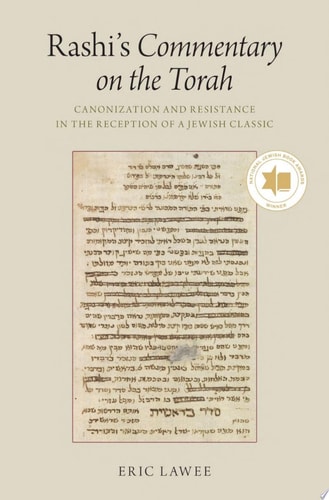
Rashi's Commentary on the Torah: Canonization and Resistance in the Reception of a Jewish Classic
0
0
As an Amazon Associate and affiliate partner, Menrva Books earns from qualifying purchases. Learn more
Author Description
Winner of the Jewish Book Council Nahum M. Sarna Memorial Award in ScholarshipThis book explores the reception history of the most important Jewish Bible commentary ever composed, the Commentary on the Torah of Rashi (Shlomo Yitzhaki; 1040-1105). Though the Commentary has benefited from enormous scholarly attention, analysis of diverse reactions to it has been surprisingly scant. Viewing its path to preeminence through a diverse array of religious, intellectual, literary, and sociocultural lenses, Eric Lawee focuses on processes of the Commentary's canonization and on a hitherto unexamined--and wholly unexpected--feature of its reception: critical, and at times astonishingly harsh, resistance to it. Lawee shows how and why, despite such resistance, Rashi's interpretation of the Torah became an exegetical classic, a staple in the curriculum, a source of shared religious vocabulary for Jews across time and place, and a foundational text that shaped the Jewish nation's collective identity.The book takes as its larger integrating perspective processes of canonicity as they shape how traditions flourish, disintegrate, or evolve. Rashi's scriptural magnum opus, the foremost work of Franco-German (Ashkenazic) biblical scholarship, faced stiff competition for canonical supremacy in the form of rationalist reconfigurations of Judaism as they developed in Mediterranean seats of learning. It nevertheless emerged triumphant in an intense battle for Judaism's future that unfolded in late medieval and early modern times. Investigation of the reception of the Commentary throws light on issues in Jewish scholarship and spirituality that continue to stir reflection, and even passionate debate, in the Jewish world today.
Menrva's Summary
THE THESIS
This work investigates the historical processes of canonization that transformed Rashi’s Commentary on the Torah from a contested medieval text into a foundational pillar of Jewish religious identity. Eric Lawee, a scholar of medieval Jewish intellectual history, utilizes a broad range of primary sources to analyze how Rashi’s work navigated intense competition from rationalist schools of thought. The book argues that the commentary's eventual dominance was not an inevitable outcome but the result of complex sociocultural negotiations and the overcoming of significant, often harsh, intellectual resistance.
THE SCOPE MAP
What You Will Find
- Analysis of the reception history of Rashi’s Torah commentary from the medieval period to the early modern era.
- Examination of the intellectual rivalry between Ashkenazic traditionalism and Mediterranean rationalist interpretations of Judaism.
- Discussion of the mechanisms of canonicity and how religious texts maintain authority over time.
Scope Limits
- The study does not provide a verse-by-verse theological analysis of the commentary itself, focusing instead on its reception and historical impact.
- The text does not cover the entirety of Rashi’s literary output, concentrating specifically on the Torah commentary.
THE AUTHORITY PERSPECTIVE
Scholars recognize this work as a significant contribution to the study of Jewish intellectual history and the sociology of religious texts. Readers frequently note the academic rigor of the prose and the depth of the historical research presented throughout the volume.
Page Count:
496
Publication Date:
2019-01-01
Publisher:
Oxford University Press
ISBN-10:
0190937858
ISBN-13:
9780190937850
Religion
History
Judaism
Jewish Studies
Literary Criticism
Bible
Theology
Biblical Commentary
History of religion
Community Tags
Other Editions(2)
Similar Books


Reader Comments
Share Your Thoughts
No comments yet. Be the first to share your thoughts!