Author Description
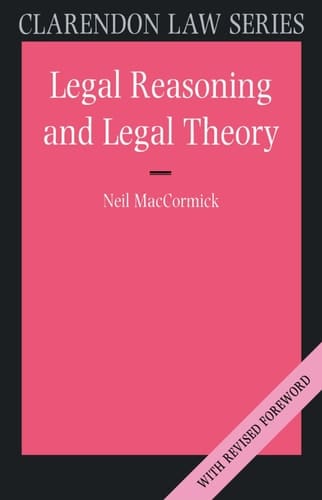
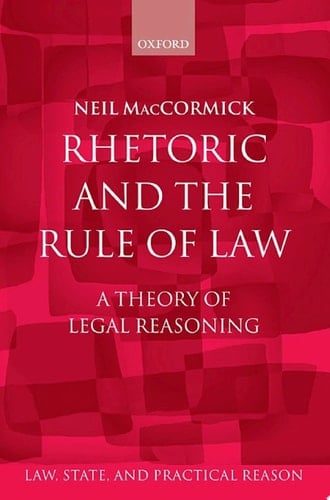
Is legal reasoning rationally persuasive, working within a discernible structure and using recognisable kinds of arguments? Does it belong to rhetoric in this sense, or to the domain of the merely 'rhetorical' in an adversative sense? Is there any reasonable certainty about legal outcomes in dispute-situations? If not, what becomes of the Rule of Law? Neil MacCormick's book tackles these questions in establishing an overall theory of legal reasoning which shows the essential part 'legal syllogism' plays in reasoning aimed at the application of law, while acknowledging that simple deductive reasoning, though always necessary, is very rarely sufficient to justify a decision. There are always problems of relevancy, classification or interpretation in relation to both facts and law. In justifying conclusions about such problems, reasoning has to be universalistic and yet fully sensitive to the particulars of specific cases. How is this possible? Is legal justification at this level consequentialist in character or principled and right-based? Both normative coherence and narrative coherence have a part to play in justification, and in accounting for the validity of arguments by analogy. Looking at such long-discussed subjects as precedent and analogy and the interpretative character of the reasoning involved, Neil MacCormick expands upon his celebrated Legal Reasoning and Legal Theory (OUP 1978 and 1994) and restates his 'institutional theory of law'.
Menrva's Summary
THE THESIS
This work investigates whether legal reasoning functions as a rationally persuasive, structured system or merely as an adversarial rhetorical exercise, and how this impacts the stability of the Rule of Law. Sir Neil MacCormick, a prominent legal philosopher, utilizes his extensive background in jurisprudence to construct a comprehensive theory of legal reasoning. He argues that while the legal syllogism is a necessary component of law application, it is rarely sufficient on its own to justify judicial decisions. The text examines the interplay between universalistic principles and the specific particulars of individual cases to determine how legal justification maintains coherence.
THE SCOPE MAP
What You Will Find
- An analysis of the institutional theory of law.
- Examination of the roles of normative and narrative coherence in legal justification.
- Discussion of precedent, analogy, and the interpretative nature of legal arguments.
Scope Limits
- The text does not provide a practical handbook for courtroom litigation or trial advocacy.
- It does not offer a comprehensive history of global legal systems, focusing instead on theoretical frameworks.
THE AUTHORITY PERSPECTIVE
Legal scholars and practitioners frequently cite this work as a significant expansion of MacCormick's earlier foundational contributions to legal theory. Readers often note the high level of academic density and the rigorous philosophical inquiry required to engage with the author's arguments.
Page Count:
306
Publication Date:
2005-01-01
Publisher:
OUP Oxford
ISBN-10:
0191018783
ISBN-13:
9780191018787
Philosophy
Jurisprudence
Rhetoric
Rule Of Law
Professional Career & Trade
Law
Law Philosophy
Legal Theory
Community Tags
Similar Books