Author Description
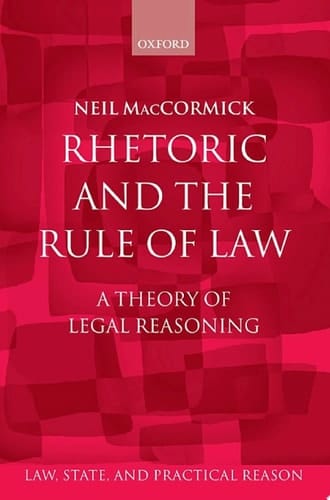
When cases come before courts can we predict the outcome? Is legal reasoning rationally persuasive, working within a formal structure and using recognizable forms of arguments to produce predictable results? Or is legal reasoning mere "rhetoric" in the pejorative sense, open to use, and abuse, to achieve whatever ends unscrupulous politicians, lawyers and judges desire? If the latter what becomes of the supposed security of living under the rule of law?This book tackles these questions by presenting a theory of legal reasoning, developing the author's classic account given in Legal Reasoning and Legal Theory (OUP, 1978). It explains the essential role syllogism plays in reasoning used to apply the law, and the elements needed in addition to deductive reasoning to give a full explanation of how law is applied and decisions justified through the use of precedent, analogy and principle.The book highlights that problems of interpretation, classification and relevance will always arise when applying general legal standards to individual cases. In justifying their conclusions about such problems, judges need to be faithful to categorical legal reasons and yet fully sensitive to the particulars of the cases before them. How can this be achieved, and how should we evaluate the possible approaches judges could take to solving these problems? By addressing these issues the book asks questions at the heart of understanding the nature of law and the moral complexity of the rule of law.
Menrva's Summary
THE THESIS
This work investigates whether legal reasoning functions as a rationally persuasive, structured system or merely as rhetorical manipulation that undermines the security of the rule of law. The late Neil MacCormick, a distinguished legal philosopher, builds upon his foundational 1978 framework to examine the mechanics of judicial decision-making. He argues that while deductive syllogism is essential, it remains insufficient on its own to explain how law is applied, necessitating a deeper look at the roles of precedent, analogy, and principle in justifying legal outcomes.
THE SCOPE MAP
What You Will Find
- An analysis of the interplay between deductive logic and interpretive legal standards.
- A theoretical framework for evaluating judicial approaches to classification and relevance.
- An examination of the moral complexities inherent in maintaining the rule of law.
- A critical review of the distinction between formal legal reasoning and pejorative rhetoric.
THE AUTHORITY PERSPECTIVE
Legal scholars and practitioners view this text as a significant refinement of MacCormick's earlier contributions to jurisprudence. Readers frequently note the academic density of the prose, which serves as a rigorous exploration of the logical structures underpinning modern legal systems.
Page Count:
304
Publication Date:
2009-11-02
Publisher:
Oxford University Press
ISBN-10:
0199571244
ISBN-13:
9780199571246
Philosophy
Law Philosophy
Rule Of Law
Legal Theory
Jurisprudence
Law
Community Tags
Similar Books