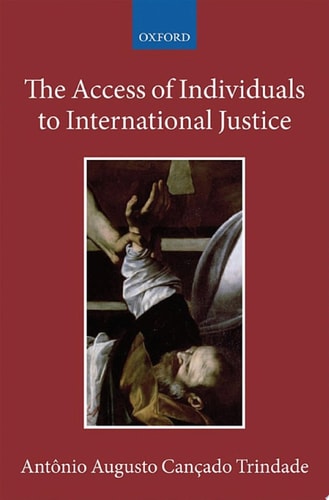
The Access of Individuals to International Justice
0
0
As an Amazon Associate and affiliate partner, Menrva Books earns from qualifying purchases. Learn more
Author Description
This book contends that the right of access to justice (at national and international levels) constitutes a basic cornerstone of the international protection of human rights, and conforms a true right to the Law. It amounts, lato sensu, to the right to the realization of justice. In such understanding, it comprises not only the formal access to a tribunal or judge, but also respect for the guarantees of due process of law, the right to a fair trial, and to reparations (whenever they are due), and the faithful execution of judgments. On its part, the right to an effective domestic remedy is a basic pillar of the rule of law in a democratic society. In its part, the right of international individual petition, together with the safeguard of the integrity of international jurisdiction, constitute the basic foundations of the emancipation of the individual vis-à-vis his own State. This is a domain that has undergone a remarkable development in recent years. It is submitted that the right of access to justice belongs today to the domain of jus cogens. Without it, there is no legal system at all. The protection of the human person in the most adverse circumstances has evolved amongst considerations of ordre public. Such recent evolution has been contributing to the gradual expansion of the material content of jus cogens. Furthermore, the very notion of "victim" (encompassing direct, indirect and potential victims) has been the subject of a considerable international case-law. Victims have had their cause vindicated in situations of utmost adversity, if not defencelessness (e.g., abandoned or "street children", undocumented migrants, members of peace communities in situations of armed conflict, internally displaced persons, individuals in infra-human conditions of detention, surviving victims of massacres).
Menrva's Summary
THE THESIS
This work investigates whether the right of access to justice constitutes a fundamental cornerstone of international human rights protection and a peremptory norm of international law (jus cogens). The author, a distinguished jurist and former judge of the International Court of Justice, utilizes an extensive analysis of international case-law and human rights jurisprudence to argue that access to justice is essential for the existence of any functioning legal system. He posits that the evolution of international law has shifted the status of the individual from a mere object of state power to an active subject capable of seeking international redress.
THE SCOPE MAP
What You Will Find
- Analysis of the right to an effective domestic remedy as a pillar of the rule of law.
- Examination of the right of international individual petition and its role in state accountability.
- Discussion of the evolving legal definition of 'victim' in international jurisprudence.
- Theoretical framework linking access to justice with the concept of jus cogens and ordre public.
Scope Limits
- The text focuses primarily on international human rights frameworks rather than specific domestic procedural codes.
- It does not provide a comprehensive manual for litigation but rather a theoretical and jurisprudential overview.
THE AUTHORITY PERSPECTIVE
Legal scholars and practitioners frequently cite this work as a foundational text for understanding the procedural evolution of human rights law. Experts highlight the author's rigorous academic approach to the intersection of individual rights and international jurisdiction.
Page Count:
266
Publication Date:
2011-01-01
Publisher:
OUP Oxford
ISBN-10:
0191018910
ISBN-13:
9780191018916
International Law
Justice Administration of
Human rights
Jurisprudence
Law
Professional Career & Trade
Academic