Lighter Than Air: The Spatial Art of Al Loving
0
0
As an Amazon Associate and affiliate partner, Menrva Books earns from qualifying purchases. Learn more
Author Description
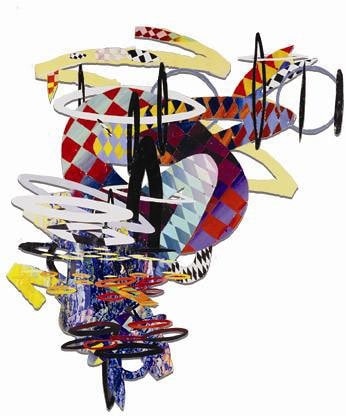
Al Loving's work is difficult to categorize. With its brilliant colors and shiny surfaces, it would at first appear to belong to the pop art tradition that started in the 1960s, but its insistence on the purely abstract takes it away from pop, which is after all a movement that started out as a reaction against modernist abstraction. Moreover, the passionate feeling and beauty that inform Loving's work place it squarely in the mainstream tradition of modernism. The pop artists - like Duchamp before them - were anxious to eliminate emotion from their pictures, and tried to escape from Renaissance canons of beauty, but Loving wants to make purely beautiful paintings that will move the viewer who is looking at them, and he succeeds. That said, the paintings in the Loving show at the G. R. N'Namdi Gallery in Chelsea differ from most abstract pictures, in which paint (with or without gel) is applied to a flat, square or rectangular surface. Rather, this artist cuts out many smaller pieces of rag paper, especially into spirals, circles, and thick doughnut shapes. Then he covers these pieces with acrylics in various colors and often with patterns: stripes, checkers, lozenges, interweaving slats. Next, he collages the pieces together to form a single larger and far more sophisticated composition which, mounted on Plexiglas or foam core, hangs several inches out in front of the wall that it is attached to, seeming indeed (as the title of the show itself says) to float in midair. These might be called "shaped canvases," but they are infinitely more complex and subtle than the shaped canvases that Richard Smith and Sven Lukin were making back in the 60s, and far more harmonious and uplifting than the garish combinations of angular shapes and dissonant colors with which Elizabeth Murray has more recently made herself known.
Menrva's Summary
THE THESIS
This text investigates the unique spatial methodology and aesthetic philosophy of artist Al Loving, questioning how his work reconciles modernist abstraction with emotional resonance. The author examines Loving's departure from traditional flat-surface painting, focusing on his transition toward three-dimensional, collage-based compositions that challenge the boundaries of the canvas. By analyzing the physical construction of his pieces, the text argues that Loving's work occupies a distinct space between pop art and traditional modernism.
THE SCOPE MAP
What You Will Find
- Analysis of Al Loving's specific collage techniques involving rag paper and acrylics
- Comparison of Loving's work against contemporaries like Richard Smith, Sven Lukin, and Elizabeth Murray
- Examination of the spatial relationship between the artwork and the gallery wall
Scope Limits
- Does not provide a comprehensive chronological biography of the artist's entire life
- Does not cover the broader socio-political history of the 1960s art scene beyond specific stylistic comparisons
THE AUTHORITY PERSPECTIVE
Critics and art historians frequently cite this text as a vital resource for understanding the technical evolution of Loving's shaped canvases. The prose is noted for its clear, descriptive approach to complex visual compositions, making it accessible to both casual gallery visitors and serious students of modern art.
Page Count:
15
Publication Date:
2004-01-01
Publisher:
G. R. N'Namdi Gallery
ISBN-10:
0191010626
ISBN-13:
9780191010620
Biography
Art
Abstract Art
Modernism
Painting
Art History
Community Tags
Similar Books