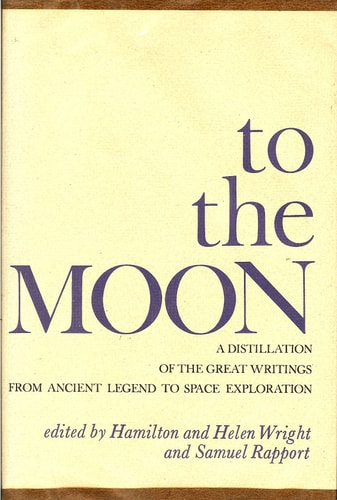
To the Moon!
0
0
As an Amazon Associate and affiliate partner, Menrva Books earns from qualifying purchases. Learn more
Author Description
From the beginning, the moon has fascinated man. At first he gazed at it in simple awe. Gradually his sense of wonder grew. The moon took on the mystical and religious significance with which he surrounded many natural objects. The legends spread; the questions multiplied: Was the moon in fact the goddess of the hunt? Could she affect the crops, the fertility of women, even the destinies of nations? The craftof astrology arose, and kings and commoners alike heeded the answers it provided. Later came the period of rational theorizing and observation. The questions asked were of a different kind: Why does the moon continue itseternal circuit round the earth? Whence comes its light and what causes its phases? Why does it vanish completely each month? And what of the belief that an object hanging in the sky can influence tides on earth-can such apparent nonsense be the truth? Each question raises multitudes of others. Some have been solved; some remain for future decades, even centuries, to answer. In this book, the editors have attempted to show something of the nature of the lunar dream, its origins, its romance, its future hopes. They have tried to trace man's contacts with the moon, both in his mind and in actuality, from earliest times to present. The story is told in the words of some who have contributed to it, like Galileo and Gagarin. It is told in the poetry of Virgil, Shelley, Keats; in the imaginative writings of Cyrano and Jules Verne, and in the hard factual expositions of the Jet Propulsion Laboratory.
Menrva's Summary
THE THESIS
This book investigates the historical, cultural, and scientific evolution of humanity's relationship with the moon. The editors, Hamilton and Helen Wright and Samuel Rapport, compile a diverse collection of primary sources and literary excerpts to examine how the lunar body has transitioned from a mystical object of worship to a subject of rigorous scientific inquiry and space exploration. By synthesizing perspectives ranging from ancient poetry to modern aerospace reports, the authors argue that the 'lunar dream' is a fundamental component of human intellectual development.
THE SCOPE MAP
What You Will Find
- Historical accounts of lunar observation from antiquity to the space age.
- Literary reflections on the moon by poets such as Virgil, Shelley, and Keats.
- Scientific and speculative writings from figures like Galileo, Cyrano de Bergerac, and Jules Verne.
- Technical documentation and reports from the Jet Propulsion Laboratory.
Scope Limits
- The text does not provide a comprehensive technical manual for modern lunar physics.
- It does not focus exclusively on the political history of the Space Race, prioritizing cultural and intellectual history instead.
THE AUTHORITY PERSPECTIVE
Readers often note the eclectic nature of this anthology, which successfully bridges the gap between humanities and hard science. Experts highlight this as a useful foundational text for those interested in the history of lunar perception and the evolution of astronomical thought.
Page Count:
300
Publication Date:
1968-01-01
Publisher:
Meredith
ISBN-10:
0191010154
ISBN-13:
9780191010156
Non-Fiction
Science
Anthology
Science History
Astronomy
Community Tags
Similar Books