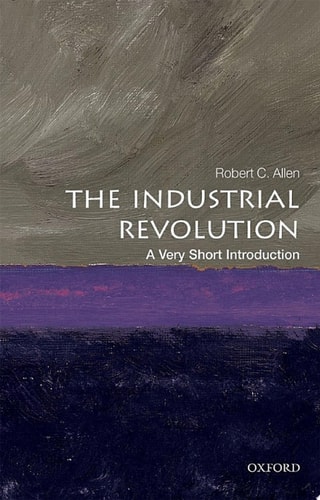
The Industrial Revolution: A Very Short Introduction
0
0
As an Amazon Associate and affiliate partner, Menrva Books earns from qualifying purchases. Learn more
Author Description
The 'Industrial Revolution' was a pivotal point in British history that occurred between the mid-eighteenth and mid-nineteenth centuries and led to far reaching transformations of society. With the advent of revolutionary manufacturing technology productivity boomed. Machines were used to spin and weave cloth, steam engines were used to provide reliable power, and industry was fed by the construction of the first railways, a great network of arteries feeding the factories. Cities grew as people shifted from agriculture to industry and commerce. Hand in hand with the growth of cities came rising levels of pollution and disease. Many people lost their jobs to the new machinery, whilst working conditions in the factories were grim and pay was low. As the middle classes prospered, social unrest ran through the working classes, and the exploitation of workers led to the growth of trade unions and protest movements. In this Very Short Introduction, Robert C. Allen analyzes the key features of the Industrial Revolution in Britain, and the spread of industrialization to other countries. He considers the factors that combined to enable industrialization at this time, including Britain's position as a global commercial empire, and discusses the changes in technology and business organization, and their impact on different social classes and groups. Introducing the 'winners' and the 'losers' of the Industrial Revolution, he looks at how the changes were reflected in evolving government policies, and what contribution these made to the economic transformation. ABOUT THE SERIES: The Very Short Introductions series from Oxford University Press contains hundreds of titles in almost every subject area. These pocket-sized books are the perfect way to get ahead in a new subject quickly. Our expert authors combine facts, analysis, perspective, new ideas, and enthusiasm to make interesting and challenging topics highly readable.
Menrva's Summary
THE THESIS
This work investigates the economic and social catalysts that enabled the Industrial Revolution to emerge in Britain and subsequently spread globally. Robert C. Allen, a professor of economic history, utilizes historical data and comparative economic analysis to argue that specific geographic, commercial, and technological conditions converged to create this transformation. He examines the interplay between high wages, cheap energy, and global trade networks to explain why Britain became the epicenter of industrialization.
THE SCOPE MAP
What You Will Find
- Analysis of the transition from agrarian economies to industrial manufacturing.
- Examination of technological advancements including steam power and textile mechanization.
- Discussion of the socio-economic impact on different classes, including the rise of trade unions.
- Comparative study of industrialization patterns in Britain versus other nations.
Scope Limits
- The text does not provide an exhaustive technical manual on specific machinery.
- It does not offer a comprehensive biography of individual inventors or political figures.
THE AUTHORITY PERSPECTIVE
Experts and academics frequently cite this text as a concise, high-level synthesis of complex economic history suitable for students and interested laypeople. Readers often note that the prose is accessible yet maintains a rigorous analytical framework typical of the Very Short Introductions series.
Page Count:
168
Publication Date:
2017-01-01
Publisher:
OUP Oxford
ISBN-10:
0191016780
ISBN-13:
9780191016783
History
Economics
Economic History
Technology
European History
British History
Great Britain
Community Tags
Other Editions(3)


Similar Books





Reader Comments
Share Your Thoughts
No comments yet. Be the first to share your thoughts!