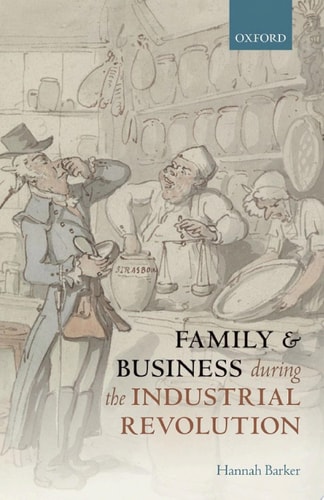
Family and Business during the Industrial Revolution
0
0
As an Amazon Associate and affiliate partner, Menrva Books earns from qualifying purchases. Learn more
Author Description
This is an open access title available under the terms of a CC BY-NC-ND 4.0 International licence. It is free to read at Oxford Scholarship Online and offered as a free PDF download from OUP and selected open access locations. Small businesses were at the heart of the economic growth and social transformation that characterized the industrial revolution in Britain. In towns across north-west England, shops and workshops dominated the streetscape, and helped to satisfy an increasing desire for consumer goods. Yet despite their significance, we know surprisingly little about these firms and the people who ran them, for whilst those engaged in craft-based manufacturing, retailing, and allied trades constituted a significant proportion of the urban population, they have been generally overlooked by historians. Instead, our view of the world of business is more usually taken up by narratives of particularly successful firms, and especially those involved in new modes of production. By examining some of the forgotten businesses of the industrial revolution, and the men and women who worked in them, Family and Business during the Industrial Revolution presents a largely unfamiliar commercial world. Its approach, which spans economic, social, and cultural history, as well as encompassing business history and the histories of the emotions, space, and material culture, alongside studies of personal testimony, testatory practice, and property ownership, tests current understandings of gender, work, family, class, and power in the late eighteenth and early nineteenth centuries. It provides us with new insights into the lives of ordinary men and women in trade, whose relatively mundane lives are easily overlooked, but who were central to the story of a pivotal period in British history.
Menrva's Summary
THE THESIS
This book investigates the role of small-scale businesses and their operators in the economic and social transformation of Britain during the Industrial Revolution. Hannah Barker, a historian specializing in the eighteenth and nineteenth centuries, utilizes a diverse array of primary sources—including personal testimonies, wills, and property records—to shift the historical focus away from large-scale industrial firms. She argues that craft-based manufacturing and retail trades were central to the period's commercial landscape and that these ordinary businesses provide a more accurate understanding of class, gender, and power dynamics than the traditional focus on large-scale production.
THE SCOPE MAP
What You Will Find
- Analysis of small businesses, shops, and workshops in north-west England.
- Examination of the intersection between family life and commercial enterprise.
- Integration of business history with the history of emotions, space, and material culture.
- Evidence derived from testatory practices and personal property records.
Scope Limits
- The study does not focus on the large-scale industrial firms or the new modes of production typically highlighted in standard histories of the era.
THE AUTHORITY PERSPECTIVE
Historians and scholars of the period recognize this work as a significant contribution to the social history of the Industrial Revolution, particularly for its focus on the overlooked 'ordinary' business owner. Readers frequently note the academic rigor of the text and its success in bridging the gap between economic data and the lived experiences of men and women in trade.
Page Count:
278
Publication Date:
2016-01-01
Publisher:
OUP Oxford
ISBN-10:
019108915X
ISBN-13:
9780191089152
History
Great Britain
Economic History
European History
British History
Gender Studies
Business History
Social History
Community Tags
Other Editions(3)

Similar Books







Reader Comments
Share Your Thoughts
No comments yet. Be the first to share your thoughts!