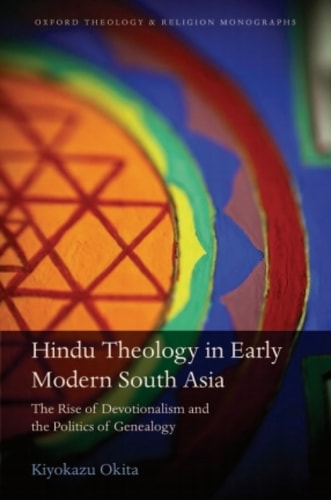
Hindu Theology in Early Modern South Asia: The Rise of Devotionalism and the Politics of Genealogy
0
0
As an Amazon Associate and affiliate partner, Menrva Books earns from qualifying purchases. Learn more
Author Description
Focusing on the idea of genealogical affiliation (sampradāya), Kiyokazu Okita explores the interactions between the royal power and the priestly authority in eighteenth-century north India. He examines how the religious policies of Jaisingh II (1688-1743) of Jaipur influenced the self-representation of Gauḍīya Vaiṣṇavism, as articulated by Baladeva Vidyābhūṣaṇa (ca. 1700-1793). Gauḍīya Vaiṣṇavism centred around God Kṛṣṇa was inaugurated by Caitanya (1486-1533) and quickly became one of the most influential Hindu devotional movements in early modern South Asia. In the increasingly volatile late Mughal period, Jaisingh II tried to establish the legitimacy of his kingship by resorting to a moral discourse. As part of this discourse, he demanded that religious traditions in his kingdom conform to what he conceived of as Brahmaṇicaly normative. In this context the Gauḍīya school was forced to deal with their lack of clear genealogical affiliation, lack of an independent commentary on the Brahmasūtras, and their worship of Goddess Radha and Kṛṣṇa, who, according to the Gauḍīyas, were not married. Based on a study of Baladeva's Brahmasūtra commentary, Kiyokazu Okita analyses how the Gauḍīyas responded to the king's demand.
Menrva's Summary
THE THESIS
This book investigates how the Gauḍīya Vaiṣṇava tradition navigated the intersection of royal authority and theological legitimacy in eighteenth-century north India. Kiyokazu Okita, a scholar of South Asian religions, utilizes primary source analysis of Baladeva Vidyābhūṣaṇa’s Brahmasūtra commentary to examine the pressures exerted by Jaisingh II of Jaipur. The work argues that the Gauḍīya school’s self-representation was fundamentally reshaped by the need to align with the king’s demand for genealogical and moral conformity during the late Mughal period.
THE SCOPE MAP
What You Will Find
- Analysis of the political influence of Jaisingh II on religious institutions.
- Examination of the theological development of Gauḍīya Vaiṣṇavism.
- Study of the Brahmasūtra commentary by Baladeva Vidyābhūṣaṇa.
- Exploration of the concept of sampradāya (genealogical affiliation) in early modern Hinduism.
Scope Limits
- The study is geographically focused on eighteenth-century north India and the kingdom of Jaipur.
- The analysis does not provide a comprehensive history of all Hindu devotional movements of the period.
THE AUTHORITY PERSPECTIVE
Scholars recognize this work as a significant contribution to the study of early modern Hindu intellectual history and the intersection of state power and religious identity. Readers frequently note the academic density of the prose, which provides a rigorous examination of sectarian self-definition within a specific historical context.
Page Count:
304
Publication Date:
2014-01-01
Publisher:
OUP Oxford
ISBN-10:
019101933X
ISBN-13:
9780191019333
History
Religion
History - Modern
Hinduism
Theology
Asian Studies
Community Tags
Similar Books