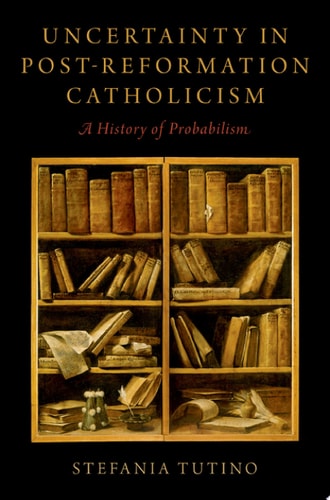
Uncertainty in Post-Reformation Catholicism: A History of Probabilism
0
0
As an Amazon Associate and affiliate partner, Menrva Books earns from qualifying purchases. Learn more
Author Description
Uncertainty in Post-Reformation Catholicism provides a historical account of early modern probabilism and its theological, intellectual, and cultural implications. First developed in the second half of the sixteenth century, probabilism represented a significant and controversial novelty in Catholic moral theology. By the second half of the seventeenth century, probabilism became and has since been associated with moral, intellectual, and cultural decadence. Stefania Tutino challenges this understanding and claims that probabilism played a central role in addressing the challenges that geographical and cultural expansions posed to traditional Catholic theology.Tutino argues that early modern theologians used probabilism to integrate major changes within the post-Reformation Catholic theological and intellectual system. Probabilist theologians realized that their time was characterized by many changes that traditional theology was not equipped to deal with, which consequently provoked an exponential growth of uncertainties, doubts, and dilemmas of conscience. Probabilism represented the result of their efforts to appreciate, come to terms with, and manage that uncertainty. Uncertainty in Post-Reformation Catholicism reinterprets probabilism as a way of dealing with moral and epistemological doubts in quickly changing times, a way that still may be useful today.Uncertainty in Post-Reformation Catholicism argues that probabilism played a central role in addressing the challenges that a geographically and intellectually expanding world posed to traditional Catholic theology. Early modern probabilist theologians realized that their time was characterized by many changes and novelties that traditional theology was not equipped to deal with, and that consequently provoked an exponential growth of uncertainties, doubts, and dilemmas of conscience. These theologians used probabilism as a means to integrate changes and novelties within the post-Reformation Catholic theologica
Menrva's Summary
THE THESIS
This book investigates the historical development and theological function of probabilism as a mechanism for navigating moral and epistemological uncertainty in early modern Catholicism. Stefania Tutino, a scholar of early modern intellectual history, utilizes primary theological texts and historical records to challenge the traditional view of probabilism as a sign of decadence. She argues instead that the framework served as a necessary, adaptive tool for integrating the rapid cultural and geographical shifts of the post-Reformation era into the existing Catholic intellectual system.
THE SCOPE MAP
What You Will Find
- Analysis of moral theology from the late sixteenth to the late seventeenth century.
- Examination of how theological systems responded to global expansion and intellectual change.
- Discussion of the relationship between conscience, doubt, and ecclesiastical authority.
Scope Limits
- The text does not provide a comprehensive history of all post-Reformation Catholic theology.
- It does not focus on the political history of the Vatican or secular state relations.
THE AUTHORITY PERSPECTIVE
Scholars recognize this work as a significant re-evaluation of a frequently misunderstood theological doctrine. Readers often note the academic density of the prose, which is intended for those familiar with early modern intellectual history and theological discourse.
Page Count:
584
Publication Date:
2017-12-01
Publisher:
Oxford University Press
ISBN-10:
0190694092
ISBN-13:
9780190694098
History
Religion
History - Modern
Christian ethics
Catholic Church
Theology
Moral Philosophy
Jesuits
Intellectual History
Catholicism
Community Tags
Other Editions(2)
Similar Books
Reader Comments
Share Your Thoughts
No comments yet. Be the first to share your thoughts!