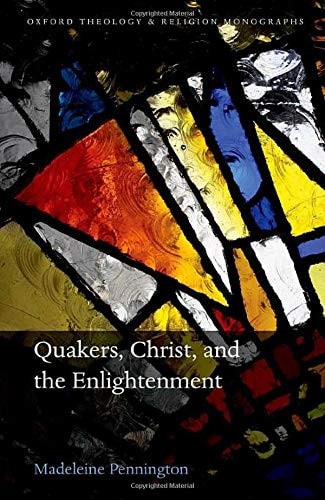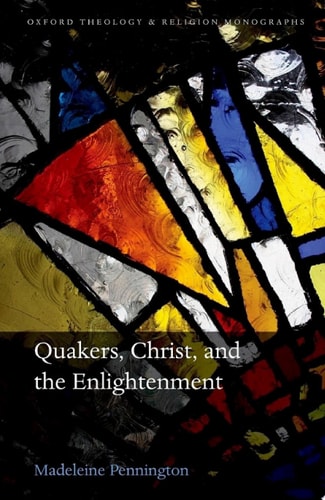
Quakers, Christ, and the Enlightenment
0
0
As an Amazon Associate and affiliate partner, Menrva Books earns from qualifying purchases. Learn more
Author Description
The Quakers were by far the most successful of the radical religious groups to emerge from the turbulence of the mid-seventeenth century--and their survival into the present day was largely facilitated by the transformation of the movement during its first fifty years. What began as a loose network of charismatic travelling preachers was, by the start of the eighteenth century, a well-organised and international religious machine. This shift is usually explained in terms of a desire to avoid persecution, but Quakers, Christ, and the Enlightenment argues instead for the importance of theological factors as the major impetus for change. In the first sustained account of the theological changes guiding the development of seventeenth-century Quakerism, Madeleine Pennington explores the Quakers' positive intellectual engagement with those outside the movement to offer a significant reassessment of the causal factors determining the development of early Quakerism. Considering the Quakers' engagement with such luminaries as Baruch Spinoza, Henry More, John Locke, and John Norris, Pennington unveils the Quakers' concerted attempts to bolster their theological reputation through the refinement of their central belief in the 'inward Christ', or 'the Light within'. In doing so, she further challenges stereotypes of early modern radicalism as anti-intellectual and ill-educated. Rather, the theological concerns of the Quakers and their interlocutors point to a crisis of Christology weaving through the intellectual milieu of the seventeenth century, which has long been under-estimated as significant fuel for the emerging Enlightenment.
Menrva's Summary
THE THESIS
This work investigates whether theological shifts, rather than mere survival instincts, served as the primary catalyst for the institutional transformation of early Quakerism during the seventeenth century. Author Madeleine Pennington, a scholar of theology and religion, utilizes a rigorous historical framework to challenge the prevailing narrative that early Quakers were primarily motivated by the need to evade persecution. By examining the movement's intellectual interactions with prominent Enlightenment figures, she argues that a deliberate refinement of Christological doctrine was the central driver of the group's evolution from a loose network of preachers into an organized international institution.
THE SCOPE MAP
What You Will Find
- Analysis of the theological development of the 'inward Christ' or 'Light within' doctrine.
- Comparative studies of Quaker engagement with thinkers such as Baruch Spinoza, Henry More, John Locke, and John Norris.
- Historical documentation of the transition from charismatic preaching to institutional organization.
Scope Limits
- The study focuses primarily on the theological and intellectual history of the movement rather than its social or political history.
- The analysis is confined to the first fifty years of the movement's existence.
THE AUTHORITY PERSPECTIVE
Scholars and historians of early modern religion recognize this text as a significant reassessment of the intellectual capabilities and theological sophistication of early Quakers. Readers frequently note the academic density of the prose, which serves as a foundational resource for those studying the intersection of radical religious movements and Enlightenment philosophy.
Page Count:
272
Publication Date:
2021-01-01
Publisher:
OUP Oxford
ISBN-10:
0192648411
ISBN-13:
9780192648419
Religion
History
Enlightenment
History - Modern
Theology
Quakerism