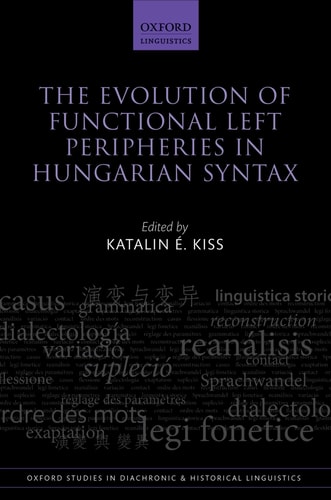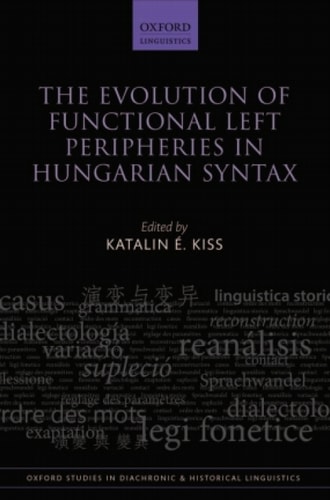
The Evolution of Functional Left Peripheries in Hungarian Syntax
0
0
As an Amazon Associate and affiliate partner, Menrva Books earns from qualifying purchases. Learn more
Author Description
This book adopts a generative framework to investigate the diachronic syntax of Hungarian, one of only a handful of non-Indo-European languages with a documented history spanning more than 800 years. Professor É. Kiss and several internationally recognized experts in the field bring together the best in traditional descriptive linguistics and the state-of-the-art in theoretical linguistics to offer an indepth and original survey of some of the most important structural changes in the history of Hungarian. The book specifically focuses on the restructuring of Hungarian syntax from head-final to head-initial, which started in the Proto-Hungarian age. This development led to fundamental structural changes, resulting in the evolution of functional left peripheries on various levels of syntactic structure by the 16th century. Chapters examine a number of related topics, including the emergence of focus, topic, and negative quantifiers, the marking of definiteness, universal quantifiers, and non-finite and finite subordination. The mechanisms of change are those observed in Indo-European languages (reanalysis, grammaticalization, cyclicity), but the paths of change have often been different. The book will be of interest to researchers and graduate students working in historical and diachronic linguistics, as well as all those interested in the mechanisms and theory of linguistic change.
Menrva's Summary
THE THESIS
This book investigates the diachronic evolution of the Hungarian language, specifically focusing on the structural shift from head-final to head-initial syntax and the subsequent development of functional left peripheries. Katalin É. Kiss, a prominent scholar in Hungarian linguistics, utilizes a generative framework to analyze over 800 years of linguistic data. By synthesizing traditional descriptive methods with modern theoretical approaches, the text provides a comprehensive account of how syntactic restructuring influenced the emergence of focus, topic, and negation markers within the language.
THE SCOPE MAP
What You Will Find
- Analysis of the transition from head-final to head-initial syntactic structures.
- Examination of the emergence of focus, topic, and negative quantifiers.
- Investigation of the marking of definiteness and universal quantifiers.
- Discussion of non-finite and finite subordination patterns.
Scope Limits
- The study is restricted to the diachronic syntax of Hungarian and does not provide a general history of the language outside of structural changes.
- The analysis focuses primarily on generative syntactic theory rather than sociolinguistic or dialectal variations.
THE AUTHORITY PERSPECTIVE
Experts recognize this work as a significant contribution to the study of non-Indo-European historical syntax. Readers frequently note the academic density of the prose, which is intended for researchers and graduate students specializing in linguistic theory.
Page Count:
288
Publication Date:
2014-01-01
Publisher:
OUP Oxford
ISBN-10:
019101978X
ISBN-13:
9780191019784
English & College Success
English
Historical linguistics
Linguistics
Syntax
Diachronic Linguistics