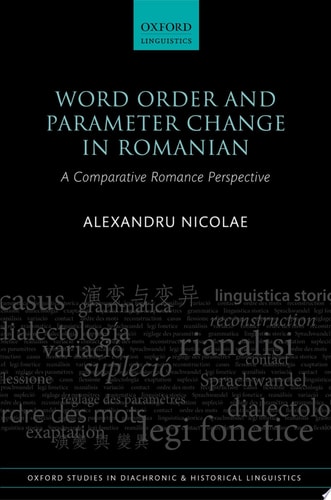
Word Order and Parameter Change in Romanian: A Comparative Romance Perspective
0
0
As an Amazon Associate and affiliate partner, Menrva Books earns from qualifying purchases. Learn more
Author Description
The book provides a comprehensive description and in-depth analysis of the major word order changes that took place in the clausal and the nominal domains in the transition from old to modern Romanian. The data are set in a comparative Romance perspective, with attention also paid to the impact of the Balkan Sprachbund and the influence of Old Church Slavonic. Alexandru Nicolae's analysis is based on a qualitative and quantitative examination of a large number of phenomena in a representative corpus of old Romanian texts. Some of these phenomena, such as scrambling, interpolation, discontinuous constituents, and variation in the position and linearization of DP-internal adjectival modifiers, are found across Romance, while others, such as the low position for pronominal cliticization, are relatively rare. Still others are specific to old and modern Romanian, such as the proclitic and enclitic realization of the same pronominal clitic, the low definite article, and the adjectival article construction. From an empirical perspective, the volume fills a gap in the Romance linguistics literature, as several of the phenomena it explores have been largely neglected to date. More broadly it offers a valuable contribution to research into word order typology and change, the nature and content of syntactic parameters, and the theory of grammaticalization and syntactic change.
Menrva's Summary
THE THESIS
This book investigates the mechanisms of word order change and syntactic parameter shifts during the transition from Old to Modern Romanian. Alexandru Nicolae, a specialist in Romanian syntax, utilizes a rigorous framework to examine how clausal and nominal structures evolved over time. By integrating qualitative and quantitative data from a representative corpus of historical texts, the author argues for a nuanced understanding of syntactic variation within the broader context of Romance languages and Balkan linguistic influences.
THE SCOPE MAP
What You Will Find
- Analysis of clausal and nominal domain word order changes
- Comparative study of Romance language syntactic phenomena
- Examination of Balkan Sprachbund and Old Church Slavonic influences
- Quantitative and qualitative corpus-based research
Scope Limits
- Focus is restricted to the transition from Old to Modern Romanian
- Does not cover contemporary sociolinguistic variations or dialectal geography
THE AUTHORITY PERSPECTIVE
Experts recognize this volume as a significant contribution to Romance linguistics, particularly for its detailed treatment of previously neglected syntactic phenomena. Scholars frequently note the academic density of the prose, making it a specialized resource for researchers in historical syntax and typology.
Page Count:
288
Publication Date:
2019-01-01
Publisher:
OUP Oxford
ISBN-10:
0192534270
ISBN-13:
9780192534279
English
Syntax
Linguistics
English & College Success
Diachronic Linguistics
Historical linguistics