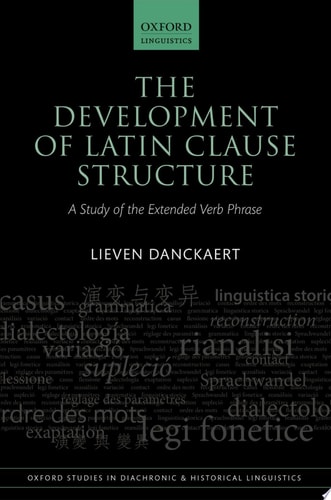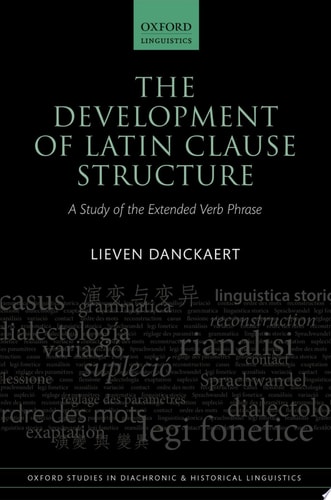
The Development of Latin Clause Structure: A Study of the Extended Verb Phrase
0
0
As an Amazon Associate and affiliate partner, Menrva Books earns from qualifying purchases. Learn more
Author Description
This book examines Latin word order, and in particular the relative ordering of i) lexical verbs and direct objects (OV vs VO) and ii) auxiliaries and non-finite verbs (VAux vs AuxV). In Latin these elements can freely be ordered with respect to each other, whereas the present-day Romance languages only allow for the head-initial orders VO and AuxV. Lieven Danckaert offers a detailed, corpus-based description of these two word order alternations, focusing on their diachronic development in the period from c. 200 BC until 600 AD. The corpus data reveal that some received wisdom needs to be reconsidered: there is in fact no evidence for any major increase in productivity of the order VO during the eight centuries under investigation, and the order AuxV only becomes more frequent in clauses with a modal verb and an infinitive, not in clauses with a BE-auxiliary and a past participle. The book also explores a more fundamental question about Latin syntax, namely whether or not the language is configurational, in the sense that a phrase structure grammar (with 'higher-order constituents' such as verb phrases) is needed to describe and analyse Latin word order patterns. Four pieces of evidence are presented that suggest that Latin is indeed a fully configurational language, despite its high degree of word order flexibility. Specifically, it is shown that there is ample evidence for the existence of a verb phrase constituent. The book thus contributes to the ongoing debate regarding the status of configurationality as a language universal.
Menrva's Summary
THE THESIS
This book investigates the syntactic evolution of Latin word order and the structural configuration of the extended verb phrase. Lieven Danckaert, a specialist in historical linguistics, utilizes an extensive corpus-based methodology to analyze the diachronic shifts in Latin syntax from 200 BC to 600 AD. By examining the interplay between lexical verbs, direct objects, and auxiliary structures, the author challenges established assumptions regarding the transition from Latin to Romance word order patterns.
THE SCOPE MAP
What You Will Find
- Longitudinal analysis of OV/VO and VAux/AuxV word order alternations.
- Corpus-based data covering an eight-century period of Latin development.
- Theoretical arguments regarding the configurational status of Latin syntax.
- Evidence supporting the existence of a verb phrase constituent in Latin.
Scope Limits
- The study focuses primarily on the period between 200 BC and 600 AD.
- The analysis does not provide a comprehensive history of all Latin grammatical features beyond the extended verb phrase.
THE AUTHORITY PERSPECTIVE
Linguists and scholars of historical syntax recognize this work as a rigorous contribution to the debate on configurationality in flexible word-order languages. Readers frequently note the technical density of the prose and the precision of the corpus-based methodology employed throughout the text.
Page Count:
352
Publication Date:
2017-01-01
Publisher:
OUP Oxford
ISBN-10:
0191077410
ISBN-13:
9780191077418
Latin Language
Syntax
Diachronic Linguistics
Linguistics
English
English & College Success
Philology
Historical linguistics