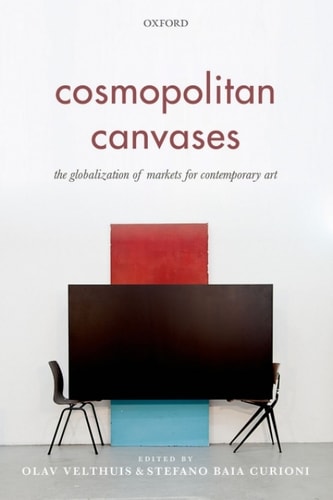
Cosmopolitan Canvases: The Globalization of Markets for Contemporary Art
0
0
As an Amazon Associate and affiliate partner, Menrva Books earns from qualifying purchases. Learn more
Author Description
Since the late 1990s, contemporary art markets have emerged rapidly outside of Europe and the United States. China is the world's second largest art market. In counties as diverse as Brazil, Turkey and India, modern and contemporary art has been recognized as a source of status, or a potential investment tool among the new middle classes. At art auctions in the US, London and Hong Kong, new buyers from emerging economies have driven up prices to record levels. The result of these changes has been an increase in complexity, interconnectedness, stratification and differentiation of contemporary art markets. Our understanding of them is still in its early stages and empirical research in the field of globalization of high arts is still scarce. This book brings together recent, multidisciplinary, cutting edge research on the globalization of art markets. Focusing on different regions, including China, Russia, India and Japan, as well as different institutions and organizations, the chapters in this volume study the extent to which art markets indeed become global. They show the various barriers to, and the effects of, globalization on the art market's organizational dynamics and the everyday narratives of people working within the art industry. In doing so, they recognize the coexistence of various ecologies of contemporary art exchange, and sketch the presence of resilient local networks of actors and organizations. Some chapters show Europe and the US continue to dominate, especially when taking art market rankings and the most powerful events such as Art Basel into account. However, other chapters argue that things such as art fairs are truly global events and that the 'architecture of the art market' which has originally been developed in Europe and the US from the 19th century onwards, is increasingly adopted across the world.
Menrva's Summary
THE THESIS
This volume investigates the extent to which contemporary art markets have become truly globalized and how they function across diverse economic and cultural landscapes. Editors Olav Velthuis and Stefano Baia Curioni, both established scholars in the sociology and economics of art, compile multidisciplinary research to analyze the shift from Western-centric market dominance to the emergence of powerful art hubs in China, India, Russia, and Brazil. The text argues that while Western institutional frameworks remain influential, local ecologies and resilient networks continue to shape the organizational dynamics of the global art industry.
THE SCOPE MAP
What You Will Find
- Comparative analysis of art market growth in emerging economies including China, Russia, India, and Japan.
- Examination of the 'architecture of the art market' and its adoption or adaptation in non-Western regions.
- Qualitative and quantitative insights into the role of art fairs, auctions, and institutional events like Art Basel.
- Sociological perspectives on the narratives of industry professionals and the motivations of new collector classes.
Scope Limits
- The book does not provide a comprehensive historical survey of art markets prior to the late 1990s.
- It does not offer investment advice or specific financial forecasting for individual art assets.
THE AUTHORITY PERSPECTIVE
Experts identify this collection as a significant contribution to the sparse empirical research on the globalization of high arts. Readers frequently note the academic density of the prose, making it a valuable resource for scholars and professionals interested in the intersection of cultural sociology and global economics.
Page Count:
464
Publication Date:
2015-01-01
Publisher:
OUP Oxford
ISBN-10:
0191027545
ISBN-13:
9780191027543
Economics
Business
Art_marketing
Humanities
Globalization
Business-to-business
Sociology
Contemporary Art
Art History
Community Tags
Similar Books