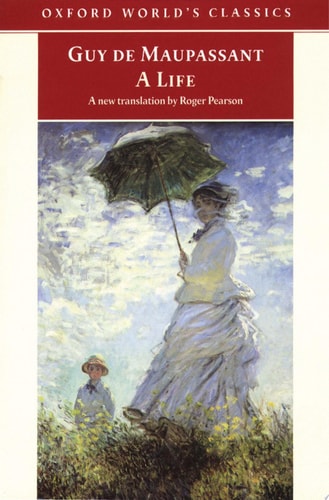
A Life
0
0
As an Amazon Associate and affiliate partner, Menrva Books earns from qualifying purchases. Learn more
Author Description
Every heart imagines itself the first to thrill to a myriad sensations which once stirred the hearts of the earliest creatures and which will again stir the hearts of the last men and women to walk the earth' What is a life? How shall a storyteller conceive a life? What if art means pattern and life has none? How, then, can any story be true to life? These are some of the questions which inform the first of Maupassant's six novels, A Life (Une Vie) (1883) in which he sought to parody and expose the folly of romantic illusion. An unflinching presentation of a woman's life of failure and disappointments, where fulfilment and happiness might have been expected, A Life recounts Jeanne de Lamare's gradual lapse into a state of disillusion. With its intricate network of parallels and oppositions, A Life reflects the influence of Flaubert in its attention to form and its coherent structure. It also expresses Maupassant's characteristic naturalistic vision in which the satire of bourgeois manners, the representation of the aristocracy in pathological decline, the undermining of human individuality and ideals, and the study of deterioration and disintegration, all play a role. But above all Maupassant brings to his first novel the short story writer's genius for a focused tension between stasis and change, and A Life is one of his most compelling portraits of dispossession and powerlessness.
Menrva's Summary
THE PULSE
The narrative follows the life of Jeanne de Lamare as she confronts the stark contrast between her romantic expectations and the harsh realities of her existence. Jeanne, a young woman of noble birth, enters adulthood with idealized visions of love and happiness, only to find her life systematically dismantled by the infidelity of her husband, the indifference of her son, and the slow erosion of her family's fortune. The novel operates as a third-person examination of a woman's decline, utilizing a chronological structure to emphasize the inevitability of her disillusionment. The primary forces opposing Jeanne are the social conventions of the 19th-century bourgeoisie and the inherent cruelty of a world that offers no respite for her misplaced idealism.
INSIDE THE PAGES
- Detailed examination of the decline of the provincial aristocracy
- Satirical critique of bourgeois manners and social expectations
- Use of intricate parallels and oppositions to structure the narrative
- Focus on the tension between stasis and inevitable change
- Unflinching portrayal of human disappointment and failure
- Naturalistic exploration of the disintegration of ideals
- Precise, controlled prose style influenced by Flaubert
- Emphasis on the themes of dispossession and powerlessness
THE COLLECTIVE ECHO
Readers and critics frequently highlight the novel's stark, unvarnished portrayal of a life defined by loss and the failure of romantic expectations. Discussion often centers on Maupassant's ability to maintain a focused tension between the protagonist's internal state and the external pressures of her environment. Many observers note the effectiveness of the author's naturalistic approach in exposing the fragility of human individuality when confronted with societal decay. The work is widely recognized for its structural coherence and its refusal to offer the reader easy comfort or sentimental resolution. Readers often appreciate the clinical precision with which the narrative tracks the slow, inevitable erosion of Jeanne's world.
Page Count:
0
Publication Date:
1999-01-01
Publisher:
Oxford University Press
ISBN-10:
019102726X
ISBN-13:
9780191027260
Classic Literature
Psychological
Naturalism
French literature
Realism
Community Tags
Similar Books