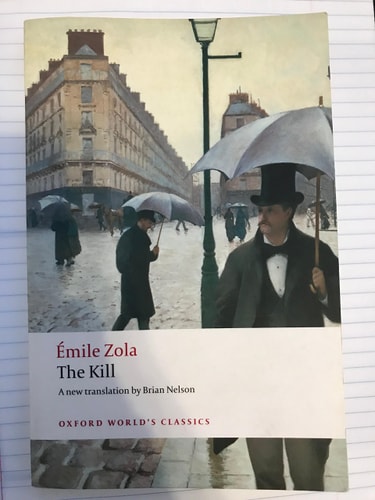
The Kill
0
0
As an Amazon Associate and affiliate partner, Menrva Books earns from qualifying purchases. Learn more
Author Description
The Kill (La Curée) is the second volume in Zola's great cycle of twenty novels, Les Rougon-Macquart, and the first to establish Paris - the capital of modernity - as the centre of Zola's narrative world. Conceived as a representation of the uncontrollable 'appetites' unleashed by the Second Empire (1852-70) and the transformation of the city by Baron Haussmann, the novel combines into a single, powerful vision the twin themes of lust for money and lust for pleasure. The all-pervading promiscuity of the new Paris is reflected in the dissolute and frenetic lives of an unscrupulous property speculator, Saccard, his neurotic wife Renée, and her dandified lover, Saccard's son Maxime.About the Series: For over 100 years Oxford World's Classics has made available the broadest spectrum of literature from around the globe. Each affordable volume reflects Oxford's commitment to scholarship, providing the most accurate text plus a wealth of other valuable features, including expert introductions by leading authorities, voluminous notes to clarify the text, up-to-date bibliographies for further study, and much more.
Menrva's Summary
THE PULSE
The novel centers on the moral decay and insatiable greed of the Parisian elite during the Second Empire, triggered by the rapid urban transformation of the city. Saccard, an unscrupulous property speculator, maneuvers through the financial and social landscape of Paris to amass wealth, while his wife Renée and his son Maxime engage in a destructive cycle of illicit desire. The narrative explores the intersection of private corruption and public expansion, utilizing a third-person perspective to observe the characters' descent into decadence. The world is defined by the physical constraints of a rapidly modernizing city and the logical constraints of a society driven by unchecked material and carnal appetites.
INSIDE THE PAGES
- Detailed depiction of the Haussmannization of Paris as a backdrop for social upheaval
- Exploration of the intersection between financial speculation and moral bankruptcy
- Character study of the Rougon-Macquart family lineage
- Use of naturalistic prose to document the environment and human behavior
- Examination of the Second Empire's political and economic climate
- Focus on the psychological disintegration of the central protagonists
- Symbolic representation of the city as a living, consuming entity
- Integration of themes regarding the commodification of human relationships
THE COLLECTIVE ECHO
Readers and critics frequently highlight the novel's unflinching portrayal of the corruption inherent in the Second Empire's rapid modernization. Discussion often centers on Zola's ability to mirror the physical destruction of old Paris with the moral erosion of his characters. The pacing is noted for its intensity, reflecting the frenetic energy of the financial markets and the characters' own volatile impulses. Scholars often emphasize the text's significance within the larger Rougon-Macquart cycle as a foundational exploration of greed and social decay. The balance between the architectural transformation of the city and the personal lives of the characters remains a primary focus for those analyzing Zola's naturalistic technique.
Page Count:
320
Publication Date:
2008-09-15
Publisher:
Oxford University Press
ISBN-10:
0199536929
ISBN-13:
9780199536924
Historical Fiction
Realism
French literature
Classic Literature