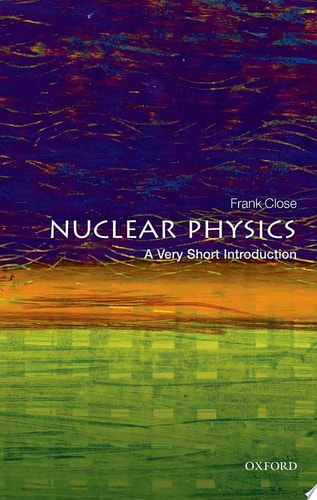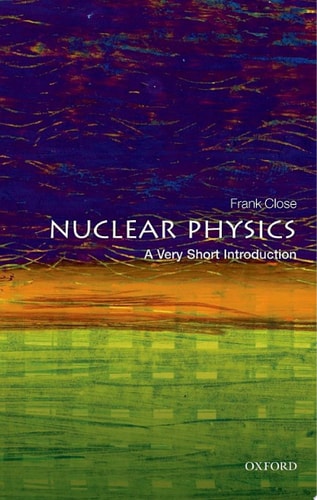
Nuclear Physics: A Very Short Introduction
0
0
As an Amazon Associate and affiliate partner, Menrva Books earns from qualifying purchases. Learn more
Author Description
Nuclear physics began long before the identification of fundamental particles, with J. J. Thomson's discovery of the electron at the end of the 19th century, which implied the existence of a positive charge in the atom to make it neutral. In this Very Short Introduction Frank Close gives an account of how this area of physics has progressed, including the recognition of how heavy nuclei are built up in the cores of stars and in supernovae, the identification of quarks and gluons, and the development of quantum chromodynamics (QCD). Exploring key concepts such as the stability of different configurations of protons and neutrons in nuclei, Frank Close shows how nuclear physics brings the physics of the stars to Earth and provides us with important applications, particularly in medicine. ABOUT THE SERIES: The Very Short Introductions series from Oxford University Press contains hundreds of titles in almost every subject area. These pocket-sized books are the perfect way to get ahead in a new subject quickly. Our expert authors combine facts, analysis, perspective, new ideas, and enthusiasm to make interesting and challenging topics highly readable.
Menrva's Summary
THE THESIS
This book investigates the historical development and fundamental principles of nuclear physics, tracing its evolution from the discovery of the electron to modern quantum chromodynamics. Professor Frank Close, a distinguished physicist, utilizes his expertise to synthesize complex atomic and subatomic concepts into a concise framework. He argues that understanding the stability of protons and neutrons is essential for grasping both the life cycles of stars and the practical applications of nuclear science in modern medicine.
THE SCOPE MAP
What You Will Find
- Historical overview of atomic theory from the late 19th century to the present.
- Explanations of quarks, gluons, and quantum chromodynamics.
- Analysis of stellar nucleosynthesis in stars and supernovae.
- Discussion of medical and practical applications of nuclear physics.
Scope Limits
- The text does not provide exhaustive mathematical derivations or advanced technical proofs.
- It does not cover the entirety of particle physics beyond the scope of nuclear interactions.
THE AUTHORITY PERSPECTIVE
Experts and readers frequently note that this text serves as an accessible entry point for those seeking a high-level overview of nuclear science. The prose is recognized for its ability to distill dense physical concepts into a readable format suitable for students and interested laypeople.
Page Count:
132
Publication Date:
2015-01-01
Publisher:
OUP Oxford
ISBN-10:
0191028738
ISBN-13:
9780191028731
Science
Non-Fiction
Earth Sciences
Physics
Nuclear Physics
Academic