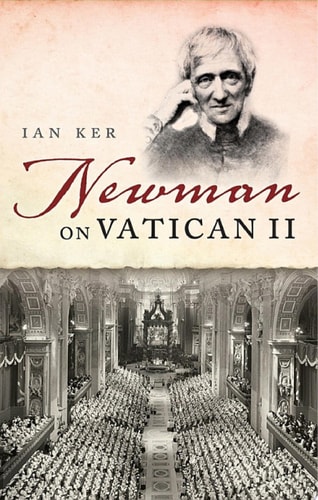
Newman on Vatican II
0
0
As an Amazon Associate and affiliate partner, Menrva Books earns from qualifying purchases. Learn more
Author Description
John Henry Newman is often described as 'the Father of the Second Vatican Council'. He anticipated most of the Council's major documents, as well as being an inspiration to the theologians who were behind them. His writings offer an illuminating commentary both on the teachings of the Council and the way these have been implemented and interpreted in the post-conciliar period. This book is the first sustained attempt to consider what Newman's reaction to Vatican II would have been. As a theologian who on his own admission fought throughout his life against theological liberalism, yet who pioneered many of the themes of the Council in his own day, Newman is best described as a conservative radical who cannot be classed simply as either a conservative or liberal Catholic. At the time of the First Vatican Council, Newman adumbrated in his private letters a mini-theology of Councils, which casts much light on Vatican II and its aftermath. The leading Newman scholar, Ian Ker, argues that Newman would have greatly welcomed the reforms of the Council, but would have seen them in the light of his theory of doctrinal development, insisting that they must certainly be understood as changes but changes in continuity rather than discontinuity with the Church's tradition and past teachings. He would therefore have endorsed the so-called 'hermeneutic of reform in continuity' in regard to Vatican II, a hermeneutic first formulated by Pope Benedict XVI and subsequently confirmed by his successor, Pope Francis, and rejected both 'progressive' and ultra-conservative interpretations of the Council as a revolutionary event. Newman believed that what Councils fail to speak of is of great importance, and so a final chapter considers the kind of evangelization--a topic notably absent from the documents of Vatican II--Newman thought appropriate in the face of secularization.
Menrva's Summary
THE THESIS
This book investigates how the theological framework of John Henry Newman provides a lens for interpreting the Second Vatican Council and its subsequent implementation. Ian Ker, a prominent scholar of Newman, utilizes the saint's private correspondence and published works to construct a hypothetical reaction to the Council. The author argues that Newman would have supported the Council's reforms through his theory of doctrinal development, framing them as a continuity of tradition rather than a rupture.
THE SCOPE MAP
What You Will Find
- Analysis of Newman's theory of doctrinal development applied to modern conciliar reforms
- Examination of Newman's private letters regarding the First Vatican Council
- Comparison of 'progressive' and 'ultra-conservative' interpretations of Vatican II
- Discussion on the role of evangelization in the context of secularization
Scope Limits
- The text does not provide a comprehensive history of the Council itself
- The analysis is limited to the specific theological perspective of John Henry Newman
THE AUTHORITY PERSPECTIVE
Scholars and theologians recognize this work as a significant contribution to the ongoing debate regarding the interpretation of Vatican II. Readers frequently note the academic density of the prose and the author's deep familiarity with Newman's corpus.
Page Count:
192
Publication Date:
2014-01-01
Publisher:
OUP Oxford
ISBN-10:
0191027073
ISBN-13:
9780191027079
Religion
History
Theology
Catholicism
Ecclesiology
Community Tags
Other Editions(4)
Similar Books

Reader Comments
Share Your Thoughts
No comments yet. Be the first to share your thoughts!