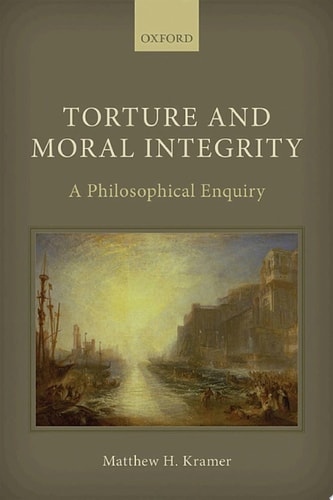
Torture and Moral Integrity: A Philosophical Enquiry
0
0
As an Amazon Associate and affiliate partner, Menrva Books earns from qualifying purchases. Learn more
Author Description
Torture and Moral Integrity tackles a concrete moral problem that has been hotly debated by governments, scholars, and the media: the morality of interrogational torture. It discusses multiple types of torture with great philosophical acuity and seeks to explain why interrogational torture and other types of torture are always and everywhere morally wrong. At the same time, it rigorously plumbs the general structure of morality and the intricacies of moral conflicts and probes some of the chief grounds for the moral illegitimacy of various modes of conduct. It defends a deontological conception of morality against the subtle critiques that have been mounted over the past few decades by proponents of consequentialism. Kramer's recommendations concerning the legal consequences of the perpetration of torture by public officials or private individuals, for example, are based squarely on his more abstract accounts of the nature of torture and the nature of morality. His philosophical reflections on the structure of morality are a vital background for his approach to torture, and his approach to torture is a natural outgrowth of those philosophical reflections.
Menrva's Summary
THE THESIS
This book investigates the moral legitimacy of interrogational torture, arguing that it is inherently and universally wrong. Matthew H. Kramer, a professor of legal and political philosophy, utilizes a rigorous deontological framework to challenge consequentialist justifications for torture. By analyzing the nature of moral integrity and the structure of moral conflicts, the author establishes a foundation for why certain acts remain impermissible regardless of their potential outcomes.
THE SCOPE MAP
What You Will Find
- A detailed philosophical analysis of various forms of torture.
- A defense of deontological ethics against modern consequentialist critiques.
- An examination of the legal implications for public officials and private individuals involved in torture.
Scope Limits
- The text does not provide a historical survey of torture practices across different civilizations.
- It does not focus on the psychological impact of torture on victims or perpetrators.
THE AUTHORITY PERSPECTIVE
Scholars and philosophers frequently cite this work for its dense, analytical approach to moral absolutism. Experts highlight the text as a significant contribution to the debate on the limits of state power and the consistency of ethical frameworks.
Page Count:
355
Publication Date:
2014-01-01
Publisher:
OUP Oxford
ISBN-10:
0191023647
ISBN-13:
9780191023644
Philosophy
Non-Fiction
Torture
Human rights
Ethics
Law
Professional Career & Trade
Community Tags
Similar Books