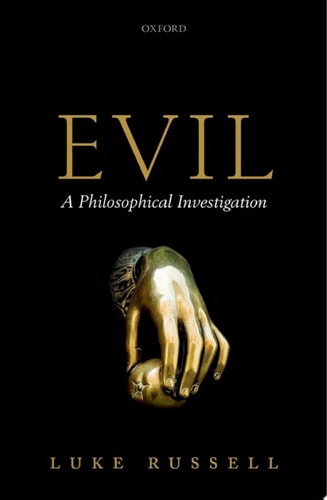
Evil: A Philosophical Investigation
0
0
As an Amazon Associate and affiliate partner, Menrva Books earns from qualifying purchases. Learn more
Author Description
When asked to describe wartime atrocities, acts of terrorism, and serial killers, many of us reach for the word 'evil'. But what does it mean to say that an action or a person is evil? Some philosophers have claimed that there is no such thing as evil, and that thinking in terms of evil is simplistic and dangerous. In response to this sceptical challenge, Luke Russell shows that concept of evil has a legitimate place within contemporary secular moral thought. In this book he addresses questions concerning the nature of evil action, such as whether evil actions must be incomprehensible, whether evil actions can be banal, and whether there is a psychological hallmark that distinguishes evils from other wrongs. Russell also explores issues regarding the nature of evil persons, including whether every evil person is an evildoer, whether every evil person is irredeemable, and whether a person could be evil merely in virtue of having evil feelings. The concept of evil is extreme, and is easily misused. Nonetheless, Russell suggests that it has an important role to play when it comes to evaluating and explaining the worst kind of wrongdoing.
Menrva's Summary
THE THESIS
This book investigates whether the concept of evil remains a valid and necessary tool for moral evaluation within contemporary secular thought. Luke Russell, a philosopher specializing in moral theory, addresses the skeptical argument that the term 'evil' is inherently simplistic or dangerous. He constructs a framework that distinguishes evil from other forms of wrongdoing, arguing that the concept provides essential clarity when analyzing extreme human behavior.
THE SCOPE MAP
What You Will Find
- Analysis of the distinction between evil actions and evil persons
- Examination of the psychological hallmarks of evil
- Discussion on the potential for redemption in individuals labeled as evil
- Evaluation of the 'banality of evil' versus incomprehensible acts
Scope Limits
- Does not provide a theological or religious definition of evil
- Does not focus on historical case studies as primary evidence, prioritizing conceptual analysis
THE AUTHORITY PERSPECTIVE
Scholars and students of ethics frequently cite this work as a rigorous defense of the utility of the concept of evil in modern moral discourse. Readers often note the clarity of the prose, which manages to navigate complex philosophical debates without becoming overly dense for an educated lay audience.
Page Count:
257
Publication Date:
2014-01-01
Publisher:
OUP Oxford
ISBN-10:
0191022810
ISBN-13:
9780191022814
Non-Fiction
Philosophy
Ethics
Good & Evil
Moral Philosophy
Community Tags
Similar Books