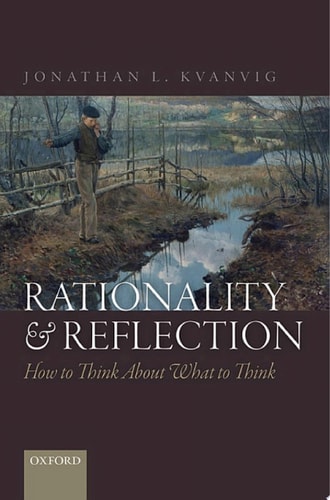
Rationality and Reflection: How to Think About What to Think
0
0
As an Amazon Associate and affiliate partner, Menrva Books earns from qualifying purchases. Learn more
Author Description
Jonathan L. Kvanvig presents a conception of rationality which answers to the need arising out of the egocentric predicament concerning what to do and what to believe. He does so in a way that avoids, on the one hand, reducing rationality to the level of beasts, and on the other hand, elevating it so that only the most reflective among us are capable of rational beliefs. Rationality and Reflection sets out a theory of rationality--a theory about how to determine what to think--which defends a significant degree of optionality in the story of what is reasonable for people to think, and thereby provides a framework for explaining what kinds of rational disagreement are possible. The theory is labelled Perspectivalism and it offers a unique account of rationality, one that cuts across the usual distinctions between Foundationalism and Coherentism and between Internalism and Externalism. It also differs significantly from Evidentialism, maintaining that, to the extent that rationality is connected to the notion of evidence, it is a function both of the evidence one has and what one makes of it.
Menrva's Summary
THE THESIS
This work investigates the core question of how individuals can maintain rational beliefs while navigating the egocentric predicament of subjective experience. Jonathan L. Kvanvig, a philosopher specializing in epistemology, constructs a theory of rationality that balances the necessity of reflection with the practical limitations of human cognition. By introducing the framework of Perspectivalism, the author argues that rationality is a function of both the evidence possessed and the individual's interpretation of that evidence, thereby allowing for reasonable disagreement among people.
THE SCOPE MAP
What You Will Find
- A comprehensive theory of rationality titled Perspectivalism
- An analysis of the relationship between evidence and belief formation
- A critique of traditional epistemological models including Foundationalism, Coherentism, Internalism, and Externalism
Scope Limits
- The text does not provide a practical self-help guide for daily decision-making
- The analysis does not cover empirical psychological studies on cognitive bias
THE AUTHORITY PERSPECTIVE
Experts in epistemology recognize this text as a significant contribution to the debate regarding the nature of rational belief and the limits of internalist versus externalist perspectives. Readers frequently note the academic density of the prose, which is intended for an audience familiar with formal philosophical discourse.
Page Count:
205
Publication Date:
2014-01-01
Publisher:
OUP Oxford
ISBN-10:
0191025755
ISBN-13:
9780191025754
Non-Fiction
Philosophy
Rationality
Epistemology
Thought And Thinking
Knowledge Theory
Logic
Community Tags
Similar Books