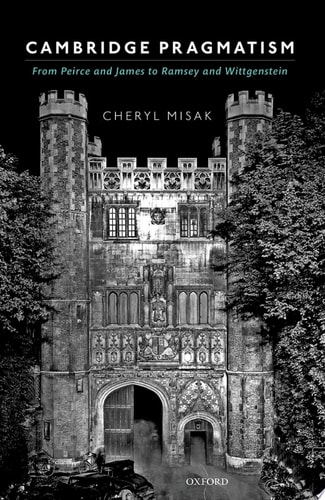
Cambridge Pragmatism
0
0
As an Amazon Associate and affiliate partner, Menrva Books earns from qualifying purchases. Learn more
Author Description
Cheryl Misak offers a strikingly new view of the development of philosophy in the twentieth century. Pragmatism, the home-grown philosophy of America, thinks of truth not as a static relation between a sentence and the believer-independent world, but rather, a belief that works. The founders of pragmatism, Peirce and James, developed this idea in more (Peirce) and less (James) objective ways. The standard story of the reception of American pragmatism in England is that Russell and Moore savaged James's theory, and that pragmatism has never fully recovered. An alternative, and underappreciated, story is told here. The brilliant Cambridge mathematician, philosopher and economist, Frank Ramsey, was in the mid-1920s heavily influenced by the almost-unheard-of Peirce and was developing a pragmatist position of great promise. He then transmitted that pragmatism to his friend Wittgenstein, although had Ramsey lived past the age of 26 to see what Wittgenstein did with that position, Ramsey would not have like what he saw.
Menrva's Summary
THE THESIS
This book investigates the neglected influence of American pragmatism on the development of early twentieth-century British philosophy, specifically through the work of Frank Ramsey. Cheryl J. Misak, a professor of philosophy, challenges the conventional narrative that British philosophers Russell and Moore successfully dismissed pragmatism. She argues that Frank Ramsey, a brilliant Cambridge polymath, integrated Peircean pragmatism into his own work and subsequently influenced Ludwig Wittgenstein, thereby altering the trajectory of analytic philosophy.
THE SCOPE MAP
What You Will Find
- An analysis of the intellectual exchange between American pragmatists Peirce and James and their British counterparts.
- A detailed examination of Frank Ramsey's philosophical development and his synthesis of pragmatist concepts.
- Historical evidence regarding the transmission of ideas between Ramsey and Wittgenstein.
Scope Limits
- The text does not provide a comprehensive history of all pragmatist thought in the twentieth century.
- It does not offer a full biography of Frank Ramsey beyond his philosophical contributions.
THE AUTHORITY PERSPECTIVE
Scholars recognize this work as a significant revisionist history that reclaims the importance of pragmatism within the Cambridge analytic tradition. Readers frequently note the academic density of the prose and the author's meticulous use of archival evidence to support her claims.
Page Count:
360
Publication Date:
2016-01-01
Publisher:
Oxford University Press
ISBN-10:
0191020044
ISBN-13:
9780191020049
Philosophy
Pragmatism
Philosophy history
Epistemology
Intellectual History
Community Tags
Similar Books