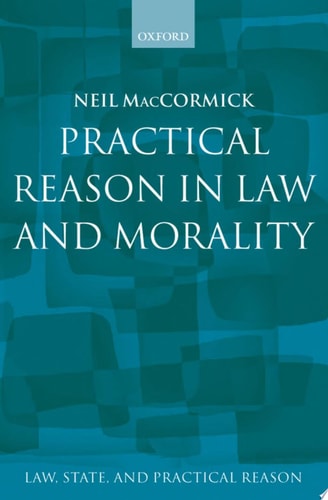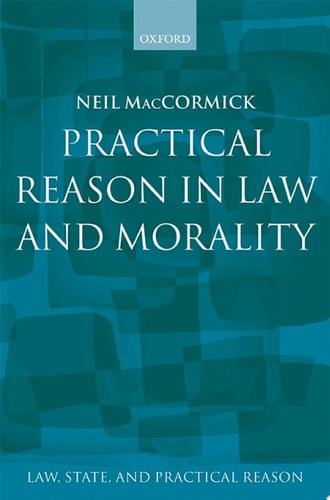
Practical Reason in Law and Morality
0
0
As an Amazon Associate and affiliate partner, Menrva Books earns from qualifying purchases. Learn more
Author Description
The concept of practical reason is central to contemporary thought on ethics and the philosophy of law - acting well means acting for good reasons. Explaining this requires several stages. How do reasons relate to actions at all, as incentives and in explanations? What are values, how do they relate to human nature, and how do they enter practical reasoning? How do the concepts of 'right and wrong' fit in, and in what way do they involve questions of mutual trust among human beings? How does our moral freedom - our freedom to form our own moral commitments - relate to our responsibilities to each other? How is this final question transposed into law and legal commitments? This book explores these questions, vital to understanding the nature of law and morality. It presents a clear account of practical reason, valuable to students of moral philosophy and jurisprudence at undergraduate or postgraduate levels. For more advanced scholars it also offers a reinterpretation of Kant's views on moral autonomy and Smith's on self-command, marrying Smith's 'moral sentiments' to Kant's 'categorical imperative' in a novel way. The book concludes and underpins the author's Law, State, and Practical Reason series. Taken together the books offer an overarching theory of the nature of law and legal reason, the role of the State, and the nature of moral reason and judgement.
Menrva's Summary
THE THESIS
This book investigates the foundational role of practical reason in ethics and the philosophy of law, specifically addressing how human actions are motivated and justified by moral commitments. Sir Neil MacCormick, a distinguished legal philosopher, synthesizes classical and modern theories to explain the relationship between individual moral autonomy and collective legal responsibility. By bridging the gap between moral sentiments and categorical imperatives, the author constructs a framework for understanding how values inform both personal judgment and state-sanctioned legal systems.
THE SCOPE MAP
What You Will Find
- A comprehensive analysis of practical reason as a driver of human action.
- A reinterpretation of Kantian moral autonomy alongside Smithian moral sentiments.
- An exploration of the intersection between individual freedom and mutual social trust.
- A theoretical foundation for the nature of law and the role of the state.
Scope Limits
- The text does not provide a practical guide for legal practitioners or courtroom strategy.
- It does not offer an exhaustive historical survey of all moral philosophy schools.
THE AUTHORITY PERSPECTIVE
Scholars and students of jurisprudence frequently identify this work as a foundational text for understanding the philosophical underpinnings of legal reasoning. Experts note the academic density of the prose, which serves as a rigorous capstone to MacCormick's broader series on law and the state.
Page Count:
230
Publication Date:
2008-01-01
Publisher:
OUP Oxford
ISBN-10:
0191021474
ISBN-13:
9780191021473
Philosophy
Political Philosophy
Jurisprudence
Law and ethics
Professional Career & Trade
Ethics
Legal Theory