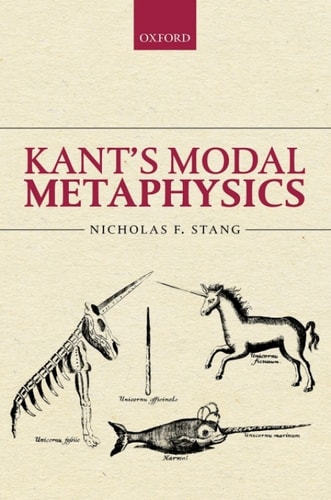
Kant's Modal Metaphysics
0
0
As an Amazon Associate and affiliate partner, Menrva Books earns from qualifying purchases. Learn more
Author Description
What is possible and why? What is the difference between the merely possible and the actual? In Kants Modal Metaphysics Nicholas Stang examines Kants lifelong engagement with these questions and their role in his philosophical development. This is the first book to trace Kants theory of possibility all theway from the so-called pre-Critical writings of the 1750s and 1760s to the Critical system of philosophy inaugurated by the Critique of Pure Reason in 1781. Stang argues that the key to understanding both the change and the continuity between Kants pre-Critical and Critical theory of possibility is his transformation of the ontological question about possibility-what is it for a being to be possible?-into a question in transcendental philosophy-what is it to represent an object as possible? The first half of Kants Modal Metaphysics explores Kants pre-Critical theory of possibility, including his answer to the ontological question about the nature of possibility, his rejection of the traditional ontological argument for the existence of God, and his own argument that God must exist to ground all possibility. The second half examines why Kant reoriented his theory of possibility around the transcendental question, what this question means, and how Kant answered it in the Critical philosophy. Stang shows that, despite this reorientation, Kants basic scheme for thinking about possibility remains constant from the pre-Critical period through the Critical system. What had been an ontological theory of possible being is reinterpreted, in the Critical system, as a theory of how we must represent possible objects, given the nature of our intellect.
Menrva's Summary
THE THESIS
This book investigates the evolution of Immanuel Kant’s theory of possibility, specifically examining how he transitioned from an ontological inquiry into the nature of possible beings to a transcendental inquiry into the representation of objects. Nicholas F. Stang, a scholar of Kantian philosophy, utilizes a chronological analysis of Kant’s writings to demonstrate that despite a significant shift in methodology, a consistent underlying framework persists throughout Kant’s intellectual development. By tracing this progression from the pre-Critical period to the publication of the Critique of Pure Reason, Stang argues that Kant’s reorientation of modal metaphysics is central to understanding his broader philosophical system.
THE SCOPE MAP
What You Will Find
- A detailed examination of Kant’s pre-Critical writings from the 1750s and 1760s.
- An analysis of the transformation of the ontological question of possibility into a transcendental question.
- A study of Kant’s rejection of traditional ontological arguments for the existence of God.
- An exploration of the role of the intellect in representing possible objects.
Scope Limits
- The text does not provide a general introduction to Kant’s entire philosophical system.
- It does not focus on Kant’s moral or political philosophy, restricting its scope to modal metaphysics.
THE AUTHORITY PERSPECTIVE
Scholars and students of Kantian studies frequently note the rigorous academic density of the prose and the precision of Stang’s historical reconstruction. Experts highlight this work as a significant contribution to understanding the continuity between Kant’s early work and his mature Critical philosophy.
Page Count:
352
Publication Date:
2016-01-01
Publisher:
OUP Oxford
ISBN-10:
0191021091
ISBN-13:
9780191021091
Philosophy
Epistemology
History & Surveys
Metaphysics
Ontology
Philosophy history
Modality logic
Immanuel Kant
Community Tags
Similar Books