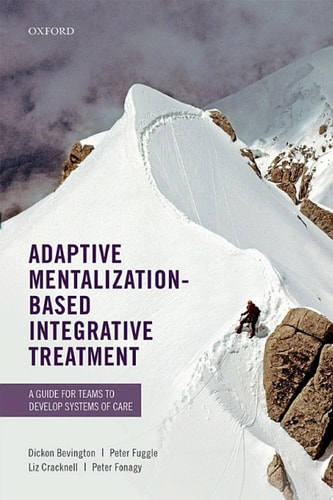
Adaptive Mentalization-Based Integrative Treatment: A Guide for Teams to Develop Systems of Care
0
0
As an Amazon Associate and affiliate partner, Menrva Books earns from qualifying purchases. Learn more
Author Description
Socially excluded youth with mental health problems and co-occurring difficulties (e.g. conduct disorder, family breakdown, homelessness, substance use, exploitation, educational failure) attract the involvement of multiple agencies. Poorly coordinated interventions often multiply in the face of such problems, so that a young person or family is approached by multiple workers from different agencies working towards different goals and using different treatment models; these are often overwhelming and may actually be experienced as aversive by the young person or their family. Failure to provide effective help is costly throughout life This is the first book to describe Adaptive Mentalization-Based Integrative Treatment (AMBIT). This is an approach to working with people - particularly young people and young adults - whose lives are often chaotic and risky, and whose problems are not limited to one domain. In addition to mental health problems, they may have problems with care arrangements, education or employment, exploitation, substance misuse, offending behaviours, and gang affiliations; if these problems are all occurring simultaneously, any progress in one area is easily undermined by harms still occurring in another. AMBIT has been designed by and for community teams from Mental Health, Social Care, Youth work, or that may be purposefully multi-disciplinary/multi-agency. It emphasises the need to strengthen integration in the complex networks that tend to gather around such clients, minimising the likelihood of an experience of care that is aversive. AMBIT uses well evidenced ‘Mentalization-based’ approaches, that are at their core integrative - drawing on recent advances in neuroscience, psycho-analytic, social cognitive, and systemic "treatment models".
Menrva's Summary
THE THESIS
This text investigates how multi-agency teams can effectively coordinate care for socially excluded youth facing complex, co-occurring mental health and social challenges. The authors, a team of clinical experts including Peter Fonagy, present the Adaptive Mentalization-Based Integrative Treatment (AMBIT) framework. This model addresses the systemic fragmentation that often occurs when multiple agencies attempt to treat high-risk individuals, proposing a structured approach to integration that draws on neuroscience, psychoanalytic theory, and systemic practice.
THE SCOPE MAP
What You Will Find
- The theoretical foundations of Mentalization-Based Treatment (MBT) adapted for community teams.
- Strategies for managing complex, multi-agency networks around high-risk youth.
- Practical methodologies for reducing aversive experiences in care delivery.
Scope Limits
- The text focuses specifically on community-based team structures rather than individual private practice therapy.
- It does not provide a comprehensive clinical manual for treating single-domain psychiatric disorders.
THE AUTHORITY PERSPECTIVE
Experts identify this as a foundational text for professionals working in multi-disciplinary youth services. Readers frequently note the high level of clinical detail and the practical utility of the framework for managing complex, real-world organizational challenges.
Page Count:
421
Publication Date:
2017-01-01
Publisher:
OUP Oxford
ISBN-10:
0191028819
ISBN-13:
9780191028816
Psychology
Mental Health
Professional Development
Youth Services
Social Work
Community Tags
Similar Books













Reader Comments
Share Your Thoughts
No comments yet. Be the first to share your thoughts!