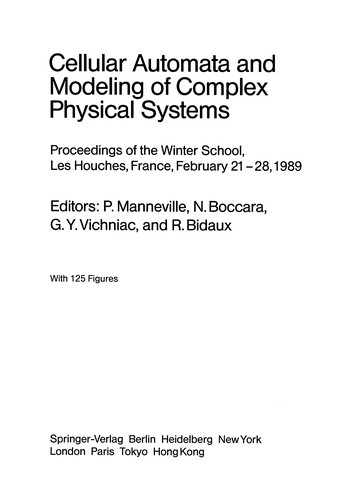
Cellular Automata and Modeling of Complex Physical Systems
0
0
As an Amazon Associate and affiliate partner, Menrva Books earns from qualifying purchases. Learn more
Author Description
Cellular automata are fully discrete dynamical systems with dynamical variables defined at the nodes of a lattice and taking values in a finite set. Application of a local transition rule at each lattice site generates the dynamics. The interpretation of systems with a large number of degrees of freedom in terms of lattice gases has received considerable attention recently due to the many applications of this approach, e.g. for simulating fluid flows under nearly realistic conditions, for modeling complex microscopic natural phenomena such as diffusion-reaction or catalysis, and for analysis of pattern-forming systems. The discussion in this book covers aspects of cellular automata theory related to general problems of information theory and statistical physics, lattice gas theory, direct applications, problems arising in the modeling of microscopic physical processes, complex macroscopic behavior (mostly in connection with turbulence), and the design of special-purpose computers.
Menrva's Summary
THE THESIS
This book investigates the theoretical underpinnings and practical applications of cellular automata in modeling complex physical systems. It explores how these discrete dynamical systems, with variables defined on a lattice and governed by local transition rules, can simulate phenomena ranging from fluid flows and diffusion-reaction processes to pattern formation and turbulence. The author delves into aspects of cellular automata theory relevant to information theory, statistical physics, and the design of specialized computers, providing a comprehensive overview of their utility in understanding microscopic physical processes and emergent macroscopic behavior.
THE SCOPE MAP
- Theoretical foundations of cellular automata, including information theory and statistical physics connections.
- Lattice gas theory and its role in simulating physical phenomena.
- Direct applications of cellular automata in modeling fluid flows and microscopic natural processes.
- Analysis of pattern-forming systems and complex macroscopic behavior, including turbulence.
- Discussion on the design of special-purpose computers for cellular automata simulations.
THE AUTHORITY PERSPECTIVE
The book is a technical exploration of cellular automata, likely appealing to researchers and advanced students in physics and computer science. Its focus on theoretical aspects and direct applications suggests a dense, academic treatment of the subject matter. The scope covers both the fundamental theory and the practical implementation of cellular automata for simulating complex physical systems, indicating a comprehensive resource for those interested in computational physics and modeling.
Page Count:
319
Publication Date:
1989-01-01
ISBN-10:
3642752594
ISBN-13:
9783642752599
Science
Non-Fiction
Modeling
Complex Systems
Physics
Computer Science
Community Tags
Similar Books