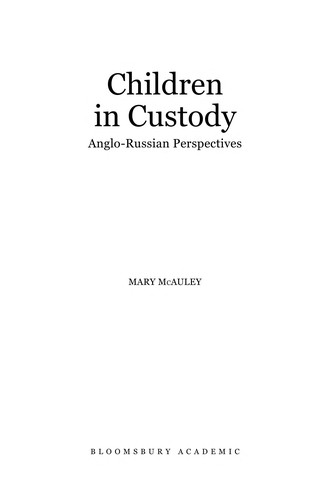
Children in Custody
0
0
As an Amazon Associate and affiliate partner, Menrva Books earns from qualifying purchases. Learn more
Author Description
Despite their very different histories, societies, political and legal systems, Russia and the UK stand out as favouring a punitive approach to young law breakers, imprisoning many more children than any other European countries. The book is based on the author's primary research in Russia in which she visited a dozen closed institutions from St Petersburg to Krasnoyarsk and on similar research in England and Northern Ireland. The result is a unique study of how attitudes to youth crime and criminal justice, the political environment and the relationship between state and society have interacted to influence the treatment of young offenders. McAuley's account of the twists and turns in policy towards youth illuminate the extraordinary history of Russia in the twentieth century and the making of social policy in Russia today. It is also the first study to compare the UK (excluding Scotland because of its separate juvenile justice system) with Russia, a comparison which highlights the factors responsible for the making of 'punitive' policy in the two societies. McAuley places the Russian and UK policies in a European context, aiming to reveal how other European countries manage to put so many fewer children behind bars.--Bloomsbury Publishing.
Menrva's Summary
THE THESIS
This book investigates the reasons behind the high rates of child imprisonment in Russia and the UK compared to other European nations. The author, Mary McAuley, draws on extensive primary research conducted in Russian closed institutions and similar research in England and Northern Ireland. The study examines how societal attitudes, political environments, and the relationship between state and society have shaped policies for young offenders. It offers a unique comparative analysis, highlighting factors contributing to punitive policies in both societies and contextualizing them within a broader European framework.
THE SCOPE MAP
- Comparative analysis of youth crime and criminal justice policies in Russia and the UK.
- Primary research findings from closed institutions in Russia and the UK.
- Examination of the interaction between societal attitudes, political environments, and youth justice.
- Illumination of 20th-century Russian history and social policy development.
- Contextualization of Russian and UK policies within the broader European landscape.
- Analysis of factors contributing to the high incarceration rates of children.
THE AUTHORITY PERSPECTIVE
This comparative study of youth justice policies in Russia and the UK is likely to be of significant interest to academics and policymakers in the fields of criminology, social policy, and comparative law. The author's direct research in closed institutions provides a unique and potentially stark perspective on the treatment of young offenders. The work aims to shed light on the systemic factors that lead to punitive approaches, offering insights into how other European nations manage to incarcerate fewer children. The comparison between two distinct political and social systems promises to reveal commonalities and divergences in the development of youth justice.
Page Count:
263
Publication Date:
2010-01-01
ISBN-10:
184966000X
ISBN-13:
9781849660006
Politics
Non-Fiction
History
Social policy
Criminology
Comparative Studies
Law
Community Tags
Similar Books