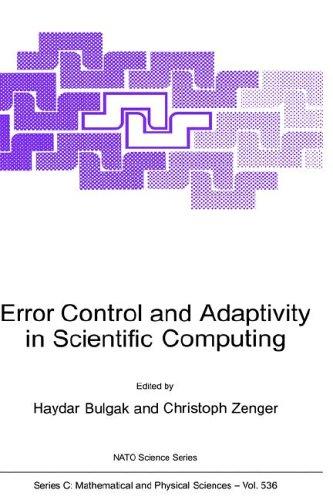
Error Control and Adaptivity in Scientific Computing
0
0
As an Amazon Associate and affiliate partner, Menrva Books earns from qualifying purchases. Learn more
Author Description
One of the main ways by which we can understand complex processes is to create computerised numerical simulation models of them. Modern simulation tools are not used only by experts, however, and reliability has therefore become an important issue, meaning that it is not sufficient for a simulation package merely to print out some numbers, claiming them to be the desired results. An estimate of the associated error is also needed. The errors may derive from many sources: errors in the model, errors in discretization, rounding errors, etc. Unfortunately, this situation does not obtain for current packages and there is a great deal of room for improvement. Only if the error can be estimated is it possible to do something to reduce it. The contributions in this book cover many aspects of the subject, the main topics being error estimates and error control in numerical linear algebra algorithms (closely related to the concept of condition numbers), interval arithmetic and adaptivity for continuous models.
Menrva's Summary
THE THESIS
The reliability of numerical simulation models is paramount in understanding complex processes, yet current tools often lack adequate error estimation. This book addresses the critical need for error control in scientific computing, acknowledging that simulation packages must provide not only results but also estimates of associated errors. These errors can stem from various sources, including model inaccuracies, discretization, and rounding. The text explores methods to estimate and reduce these errors, thereby improving the trustworthiness of computational results.
THE SCOPE MAP
- Error estimates and error control in numerical linear algebra algorithms.
- The concept and application of condition numbers in error analysis.
- The role and implementation of interval arithmetic in numerical computations.
- Adaptivity techniques for continuous models in scientific computing.
- Discussion of various error sources in numerical simulations.
THE AUTHORITY PERSPECTIVE
This collection of contributions focuses on the essential aspects of error control and adaptivity in scientific computing. The emphasis on providing error estimates alongside simulation results highlights a practical concern for users of modern computational tools. The book's structure suggests a deep dive into both theoretical underpinnings and algorithmic implementations, particularly within numerical linear algebra and interval arithmetic. It aims to equip readers with the knowledge to not only identify but also mitigate errors in complex simulations.
Page Count:
372
Publication Date:
1999-01-01
ISBN-10:
0792358090
ISBN-13:
9780792358091
Non-Fiction
Science
Numerical analysis
Scientific Computing
Computer Science
Community Tags
Similar Books