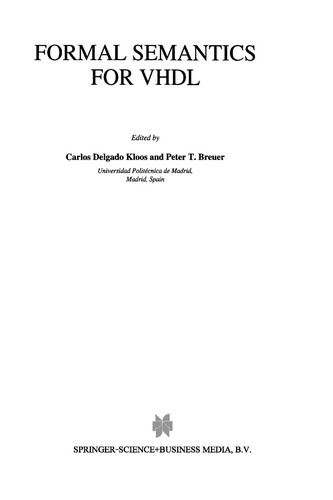
Formal Semantics for VHDL
0
0
As an Amazon Associate and affiliate partner, Menrva Books earns from qualifying purchases. Learn more
Author Description
It is recognized that formal design and verification methods are an important requirement for the attainment of high quality system designs. The field has evolved enormously during the last few years, resulting in the fact that formal design and verification methods are nowadays supported by several tools, both commercial and academic. If different tools and users are to generate and read the same language then it is necessary that the same semantics is assigned by them to all constructs and elements of the language. The current IEEE standard VHDL language reference manual (LRM) tries to define VHDL as well as possible in a descriptive way, explaining the semantics in English. But rigor and clarity are very hard to maintain in a semantics defined in this way, and that has already given rise to many misconceptions and contradictory interpretations. Formal Semantics for VHDL is the first book that puts forward a cohesive set of semantics for the VHDL language. The chapters describe several semantics each based on a different underlying formalism: two of them use Petri nets as target language, and two of them higher order logic. Two use functional concepts, and finally another uses the concept of evolving algebras. Formal Semantics for VHDL is essential reading for researchers in formal methods and can be used as a text for an advanced course on the subject.
Menrva's Summary
THE THESIS
This book addresses the critical need for a precise and unambiguous definition of the VHDL language's semantics. The existing IEEE standard VHDL Language Reference Manual (LRM) defines semantics descriptively in English, which has led to misconceptions and contradictory interpretations. This work provides the first cohesive set of formal semantics for VHDL, essential for ensuring consistency across different tools and users. It explores multiple formalisms to achieve this rigor.
THE SCOPE MAP
- Formal semantics for VHDL based on Petri nets
- Formal semantics for VHDL based on higher-order logic
- Formal semantics for VHDL based on functional concepts
- Formal semantics for VHDL based on evolving algebras
- Discussion of the importance of formal methods in high-quality system design
- Analysis of the limitations of descriptive semantic definitions
THE AUTHORITY PERSPECTIVE
This book is recognized as essential reading for researchers in formal methods and serves as a valuable text for advanced courses on the subject. Its contribution lies in providing a cohesive and rigorous set of formal semantics for VHDL, addressing the ambiguities inherent in descriptive definitions. The exploration of multiple underlying formalisms offers a comprehensive approach to understanding and implementing VHDL semantics.
Page Count:
249
Publication Date:
1995-01-01
ISBN-10:
1461359414
ISBN-13:
9781461359418
Science & Technology
Non-Fiction
Formal Methods
Computer Science
Community Tags
Similar Books