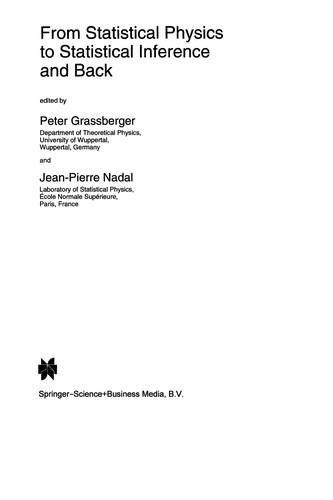
From Statistical Physics to Statistical Inference and Back
0
0
As an Amazon Associate and affiliate partner, Menrva Books earns from qualifying purchases. Learn more
Author Description
Physicists, when modelling physical systems with a large number of degrees of freedom, and statisticians, when performing data analysis, have developed their own concepts and methods for making the 'best' inference. But are these methods equivalent, or not? What is the state of the art in making inferences? The physicists want answers. More: neural computation demands a clearer understanding of how neural systems make inferences; the theory of chaotic nonlinear systems as applied to time series analysis could profit from the experience already booked by the statisticians; and finally, there is a long-standing conjecture that some of the puzzles of quantum mechanics are due to our incomplete understanding of how we make inferences. Matter enough to stimulate the writing of such a book as the present one. But other considerations also arise, such as the maximum entropy method and Bayesian inference, information theory and the minimum description length. Finally, it is pointed out that an understanding of human inference may require input from psychologists. This lively debate, which is of acute current interest, is well summarized in the present work.
Menrva's Summary
THE THESIS
This book investigates the potential equivalencies and divergences between the inference methods developed by physicists modeling complex systems and statisticians performing data analysis. The author, Peter Grassberger, addresses the pressing need for clarity in inference methods driven by fields like neural computation and the analysis of chaotic nonlinear systems, while also touching upon long-standing conjectures in quantum mechanics. It explores concepts such as the maximum entropy method, Bayesian inference, information theory, and the minimum description length principle, suggesting that a comprehensive understanding of human inference may even require input from psychology.
THE SCOPE MAP
- Comparison of inference methods used in statistical physics and statistical inference.
- Discussion of the state-of-the-art in making inferences.
- Applications in neural computation and understanding neural systems.
- Relevance to the theory of chaotic nonlinear systems and time series analysis.
- Exploration of the maximum entropy method.
- Examination of Bayesian inference.
- Coverage of information theory.
- Introduction to the minimum description length principle.
THE AUTHORITY PERSPECTIVE
The book is presented as a summary of a lively debate of acute current interest, aiming to answer questions posed by physicists regarding the equivalence of their methods to those of statisticians. It highlights the interdisciplinary nature of inference, suggesting contributions from psychology to a fuller understanding of human inference. The work covers a range of advanced topics including maximum entropy, Bayesian inference, and information theory, positioning itself as a valuable resource for those engaged in these complex fields.
Page Count:
364
Publication Date:
1994-01-01
ISBN-10:
9401110689
ISBN-13:
9789401110686
Science
Non-Fiction
Art
Bayesian Inference
Statistical Inference
Data Analysis
Information Theory
Statistical physics
Community Tags
Similar Books