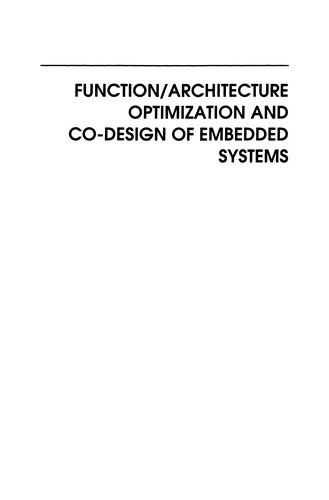
Function/Architecture Optimization and Co-Design of Embedded Systems
0
0
As an Amazon Associate and affiliate partner, Menrva Books earns from qualifying purchases. Learn more
Author Description
Function Architecture Co-Design is a new paradigm for the design and implementation of embedded systems. Function/Architecture Optimization and Co-Design of Embedded Systems presents the authors' work in developing a function/architecture optimization and co-design formal methodology and framework for control-dominated embedded systems. The approach incorporates both data flow and control optimizations performed on a suitable novel intermediate design task representation. The aim is not only to enhance productivity of the designer and system developer, but also to improve quality of the final synthesis outcome. Function/Architecture Optimization and Co-Design of Embedded Systems discusses the proposed function/architecture co-design methodology, focusing on design representation, optimization, validation, and synthesis. Throughout the text, the difference between behavior specification and implementation is emphasized. The current need in co-design to move from synthesis-based technology to compiler-based technology is pointed out. The authors describe and show how performing data flow and control optimizations at the high abstraction level can lead to significant size and performance improvements in both the synthesized hardware and software. The work builds on bodies of research in the silicon and software compilation domains. The aforementioned techniques are specialized to the embedded systems domain. It is recognized that guided optimization can be applied on the internal design representation, no matter what the abstraction level, and need not be restricted to the final stages of software assembly code generation, or hardware synthesis. Function/Architecture Optimization and Co-Design of Embedded Systems will be of primary interest to researchers, developers, and professionals in the field of embedded systems design.
Menrva's Summary
THE THESIS
This book presents a novel formal methodology and framework for the co-design and optimization of embedded systems, particularly those dominated by control functions. The approach integrates data flow and control optimizations using a unique intermediate design task representation. It aims to boost designer productivity and enhance the quality of the final synthesized system, emphasizing the distinction between behavioral specification and implementation. The work advocates for a shift from synthesis-based to compiler-based technology in co-design, demonstrating how high-level optimizations yield significant improvements in both hardware and software.
THE SCOPE MAP
- A formal methodology and framework for function/architecture optimization and co-design.
- Discussion of a novel intermediate design task representation for data flow and control optimizations.
- Emphasis on the difference between behavior specification and implementation in embedded systems.
- Exploration of the transition from synthesis-based to compiler-based technology in co-design.
- Analysis of how high-level optimizations impact synthesized hardware and software.
- Building upon research in silicon and software compilation domains, specialized for embedded systems.
- Recognition of guided optimization's applicability across abstraction levels, not just final code generation.
THE AUTHORITY PERSPECTIVE
The book is primarily of interest to researchers, developers, and professionals in embedded systems design. Its focus on a new paradigm for embedded system design suggests it offers advanced techniques for those working in the field. The methodology presented aims to improve both the design process and the final product quality. The work bridges concepts from silicon and software compilation, tailoring them for the specific challenges of embedded systems.
Page Count:
248
Publication Date:
2000-01-01
ISBN-10:
1461369592
ISBN-13:
9781461369592
Science & Technology
Health
Psychology
Non-Fiction
Science
Computer Science
Software Engineering
Community Tags
Similar Books