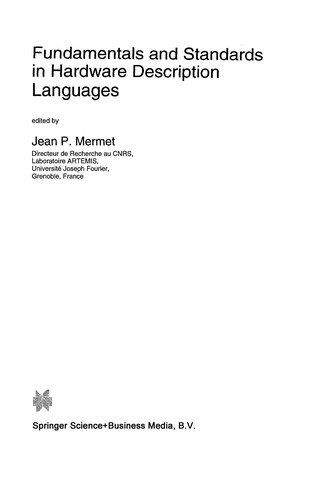
Fundamentals and Standards in Hardware Description Languages
0
0
As an Amazon Associate and affiliate partner, Menrva Books earns from qualifying purchases. Learn more
Author Description
Ultimately, every theoretical `mathematical machine' needs translation into a physical form, and this is what hardware is all about. The invention of hardware description languages (HDLs) in the early 1960s was an attempt to remain at an abstract level in the design process, pushing the stage of physical implementation to the point at which no more technology-independent decisions need to be made. It was also an answer to the continuous, exponential growth in the complexity of the systems to be designed. This complexity has meant that systems have become unmanageable in human terms, requiring CAD support. Furthermore, HDL descriptions remain `implementation free', although increasingly precise and complete, meaning that the same system can undergo successive implementations over several technological generations. The first part of Fundamentals and Standards in Hardware Description Languages takes a look back over several decades, describing the mathematics, high level language concepts and system level methodology. This helps the reader to assimilate the theoretical background to the advanced application domains of HDLs, which are dealt with in the second part of the book. The third part provides a sampling of the most recent, fully implemented HDLs, demonstrating how new concepts can become a reality, how long it takes, and how long it will take to complete HDL up to the present level of knowledge.
Menrva's Summary
THE THESIS
The design of complex electronic systems necessitates abstract representation through hardware description languages (HDLs) to manage complexity and defer physical implementation. The invention of HDLs in the early 1960s aimed to keep the design process at a high level of abstraction, delaying the transition to physical implementation until all technology-independent decisions were finalized. This approach was crucial for handling the exponential growth in system complexity, which rendered manual management impossible and necessitated Computer-Aided Design (CAD) support. HDL descriptions remain implementation-free, allowing for successive implementations across different technological generations while maintaining precision and completeness.
THE SCOPE MAP
- Historical overview of HDLs from the early 1960s to the early 1990s.
- Exploration of the mathematical and high-level language concepts underlying HDL design.
- Discussion of system-level methodology in hardware design.
- Examination of advanced application domains for HDLs.
- Presentation of recent, fully implemented HDLs and their development timelines.
- Analysis of the transition from new concepts to practical HDL implementation.
- Coverage of the theoretical background necessary for understanding advanced HDL applications.
THE AUTHORITY PERSPECTIVE
This book provides a comprehensive historical and technical overview of hardware description languages, tracing their evolution from early concepts to practical implementations. It is structured to guide readers through the theoretical underpinnings before delving into advanced applications and contemporary HDL examples. The text aims to bridge the gap between abstract mathematical models and the physical realities of hardware design. The detailed historical perspective and sampling of current HDLs offer valuable insights into the development and application of these critical design tools.
Page Count:
466
Publication Date:
1993-01-01
ISBN-10:
9401048460
ISBN-13:
9789401048460
Science
Non-Fiction
Science & Technology
Engineering
Computer Science
Technology
Community Tags
Similar Books