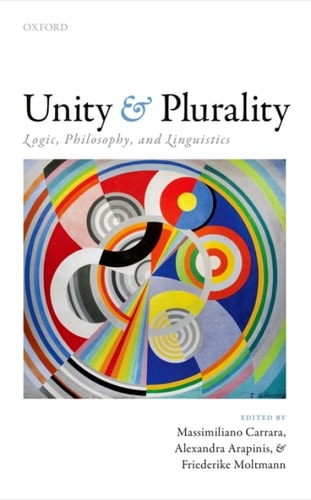
Unity and Plurality: Logic, Philosophy, and Linguistics
0
0
As an Amazon Associate and affiliate partner, Menrva Books earns from qualifying purchases. Learn more
Author Description
Unity and Plurality presents novel ways of thinking about plurality while casting new light on the interconnections among the logical, philosophical, and linguistic aspects of plurals. The volume brings together new work on the logic and ontology of plurality and on the semantics of plurals in natural language. Plural reference, the view that definite plurals such as 'the students' refer to several entities at once (the individual students), is an approach favoured by logicians and philosophers, who take sentences with plurals ('the students gathered') not to be committed to entities beyond individuals, entities such as classes, sums, or sets. By contrast, linguistic semantics has been dominated by a singularist approach to plurals, taking the semantic value of a definite plural such as 'the students' to be a mereological sum or set. Moreover, semantics has been dominated by a particular ontological view of plurality, that of extensional mereology. This volume aims to build a bridge between the two traditions and to show the fruitfulness of nonstandard mereological approaches. A team of leading experts investigates new perspectives that arise from plural logic and non-standard mereology and explore novel applications to natural language phenomena.
Menrva's Summary
THE THESIS
This volume investigates how to reconcile the disparate logical, philosophical, and linguistic frameworks used to understand plurality. The authors, a team of leading experts in their respective fields, examine the tension between plural reference—which avoids commitment to collective entities—and the singularist approach dominant in linguistic semantics. By integrating plural logic with non-standard mereology, the text argues for a more unified ontological and semantic understanding of plural expressions in natural language.
THE SCOPE MAP
What You Will Find
- Analysis of plural reference versus mereological sum or set-based semantics.
- Exploration of non-standard mereological approaches to linguistic phenomena.
- Comparative study of logical and philosophical frameworks regarding plural entities.
Scope Limits
- The text does not provide a comprehensive history of all mereological theories.
- It focuses primarily on formal and analytical perspectives rather than sociolinguistic or historical linguistics.
THE AUTHORITY PERSPECTIVE
Experts identify this collection as a significant contribution to the intersection of formal semantics and analytic philosophy. Readers frequently note the high level of technical density, making it a resource primarily intended for researchers and advanced students in logic and linguistics.
Page Count:
256
Publication Date:
2016-01-01
Publisher:
OUP Oxford
ISBN-10:
0191025623
ISBN-13:
9780191025624
Philosophy
Linguistics
Academic
Semantics
Logic & Critical Reasoning
Pluralism
Logic
Ontology
Community Tags
Similar Books