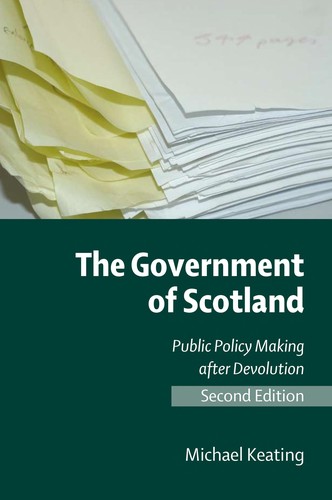
The Government of Scotland
0
0
As an Amazon Associate and affiliate partner, Menrva Books earns from qualifying purchases. Learn more
Author Description
A critical challenge to Scotland's new system of government is the making and implementation of public policy. This book offers a comprehensive account of the policy process in contemporary Scotland. There is a review of theories of policy-making, focusing on decentralised systems. The author then identifies the key actors and institutions, patterns of policy making, and the extent of convergence and divergence in comparison with England and other devolved territories. Case studies of policy making in health, higher education, housing, criminal justice, social inclusion and economic development.
Menrva's Summary
THE THESIS
This book critically examines the challenges inherent in the creation and execution of public policy within Scotland's newly established governmental system. It provides a thorough analysis of contemporary Scottish policy-making, beginning with a review of theories relevant to decentralized systems. The author then delineates the principal actors and institutions, maps out policy-making patterns, and assesses the degree of similarity or difference when compared to England and other devolved regions.
THE SCOPE MAP
- Review of theories of policy-making in decentralized systems.
- Identification of key actors and institutions in Scottish policy-making.
- Analysis of patterns in policy formulation and implementation.
- Comparison of policy convergence and divergence with England and other devolved territories.
- Case studies of policy-making in health.
- Case studies of policy-making in higher education.
- Case studies of policy-making in housing.
- Case studies of policy-making in criminal justice, social inclusion, and economic development.
THE AUTHORITY PERSPECTIVE
The book is presented as a comprehensive account of policy-making in contemporary Scotland, suggesting it aims to be a foundational text for understanding the nation's governmental processes. Its structure, moving from theoretical frameworks to specific case studies, indicates a methodical approach to analyzing complex political and administrative issues. The comparative element, contrasting Scotland with England and other devolved territories, points to an analysis that seeks to contextualize Scotland's unique policy landscape within a broader UK framework. The detailed case studies across various sectors signal an in-depth exploration of practical policy challenges and outcomes.
Page Count:
288
Publication Date:
2010-01-01
ISBN-10:
0748642242
ISBN-13:
9780748642243
History
Science
Politics
Non-Fiction
Government
Community Tags
Similar Books