High-Level System Modeling
0
0
As an Amazon Associate and affiliate partner, Menrva Books earns from qualifying purchases. Learn more
Author Description
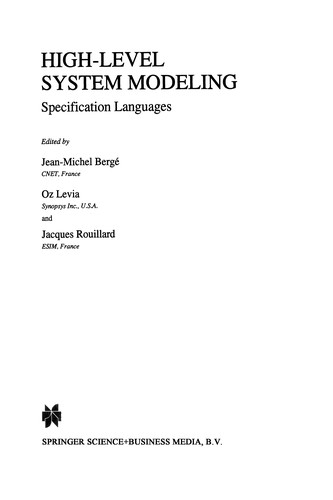
The process of modeling hardware involves a certain duality: a model may specify and represent the desires and constraints of the designer, or it may imitate something that already exists, and can end in simulation or documentation. Surprisingly enough, one of the main qualities of a specification formalism is its ability to ignore issues that do not belong to this level. Such formalisms are obviously intended for the first stages of a design, but can also be used in the process of redesign. Having a proper level of description thus avoids two symmetric problems: Overspecification, which would introduce new instances of the hardware constraints that were only meaningful to the previous ones; Underspecification, which would lead to unnecessary work and sometimes to starting again from scratch. £/LIST£ High-Level System Modeling: Specification Languages describes the state-of-the-art in specification formalisms in electronic design. The book provides an overview of object- oriented methodologies. It goes on to highlight several formalisms such as VSPEC, ESTELLE, SDL and LOTOS with methods that map their semantics to simulatable or synthesisable VHDL. Audience: The essential update for researchers, design engineers and technical managers working in design automation and circuit design.
Menrva's Summary
THE THESIS
This book explores the critical role of specification formalisms in the high-level modeling of hardware design. It addresses the duality of hardware modeling, where models can either represent designer intent and constraints or imitate existing systems, leading to simulation or documentation. The text emphasizes the importance of choosing formalisms that ignore irrelevant details to prevent overspecification and underspecification, thereby avoiding redundant work and the need to restart design processes. It is intended for use in the initial stages of design as well as in redesign efforts.
THE SCOPE MAP
- Overview of object-oriented methodologies in hardware design.
- Detailed examination of specification formalisms including VSPEC, ESTELLE, SDL, and LOTOS.
- Methods for mapping the semantics of these formalisms to simulatable or synthesisable VHDL.
- Discussion on the duality of hardware modeling: specification vs. imitation.
- Analysis of the risks of overspecification and underspecification in design.
- Application of high-level modeling in both initial design and redesign phases.
- Target audience: researchers, design engineers, and technical managers in design automation and circuit design.
THE AUTHORITY PERSPECTIVE
The book serves as an essential update for professionals in design automation and circuit design, offering insights into the state-of-the-art in specification formalisms. It highlights key formalisms and their application in creating simulatable and synthesisable VHDL, addressing common design challenges like overspecification and underspecification. The content is structured to be relevant for both initial design phases and redesign efforts.
Page Count:
162
Publication Date:
1995-01-01
ISBN-10:
1461359732
ISBN-13:
9781461359739
Science & Technology
Non-Fiction
Engineering
Technology
Computer Science
Community Tags
Similar Books