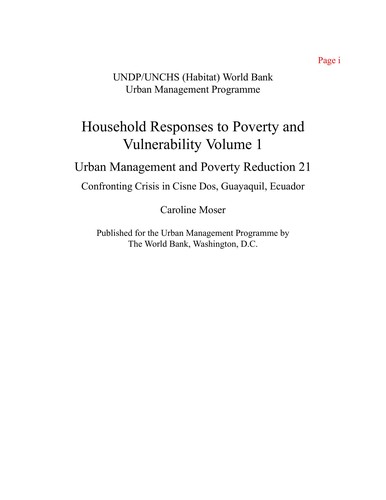
Household responses to poverty and vulnerability. Vol. 1, confronting crisis in Cisne Dos, Guayaquil, Ecuador
0
0
As an Amazon Associate and affiliate partner, Menrva Books earns from qualifying purchases. Learn more
Author Description
This case study presents the main findings from the community of Cisne Dos, in Guayaquil, Ecuador. The study explored how poor households respond to changes in economic circumstances and labor market conditions, what strategies they adopt to limit the impact of shocks and generate additional resources, and what constraints impede their actions. Three features distinguish this study from other poverty studies:a micro-level approach combining households and communities as the main units of analysis, an unusually long period of observation for some communities and households, and a comparative framework offering fours cases with very different economic development levels and institutional contexts. The study concludes with some priority recommendations for action:1) support households in their role as safety net; 2) alleviate constraints on women's labor supply; 3) ensure that social capital is not taken for granted; 4) develop social policy that integrates human capital and social capital; 5) pursue further research; and 6) develop tools and indicators to strengthen the assets of the poor.
Menrva's Summary
THE THESIS
This case study investigates the multifaceted responses of impoverished households in Guayaquil, Ecuador, to economic instability and vulnerability. The research, conducted in Cisne Dos, examines the strategies employed by these households to mitigate the effects of economic shocks and secure additional resources, while also identifying the obstacles that hinder their efforts. The study distinguishes itself through its micro-level approach, integrating household and community analyses, extended observation periods, and a comparative framework across diverse economic contexts.
THE SCOPE MAP
- Analysis of household strategies for coping with economic shocks and generating resources in an urban poverty context.
- Exploration of the constraints that impede the actions of poor households, particularly concerning labor market conditions.
- A micro-level approach combining households and communities as the primary units of analysis.
- An extended period of observation for select communities and households.
- A comparative framework offering four cases with different economic development levels and institutional contexts.
- Priority recommendations for policy action, including support for household safety nets, alleviation of constraints on women's labor supply, and integration of human and social capital in social policy.
THE AUTHORITY PERSPECTIVE
This study is positioned as a detailed examination of poverty and vulnerability at the household and community level within a specific urban context. The research methodology, emphasizing a micro-level approach and extended observation, suggests a deep dive into the lived experiences of the poor. The concluding recommendations point towards a policy-oriented focus, aiming to inform interventions that strengthen the assets and resilience of vulnerable populations.
Page Count:
160
Publication Date:
1997-01-01
ISBN-10:
0821338471
ISBN-13:
9780821338476
Health
Economics
Non-Fiction
History
Social policy
Community Tags
Similar Books