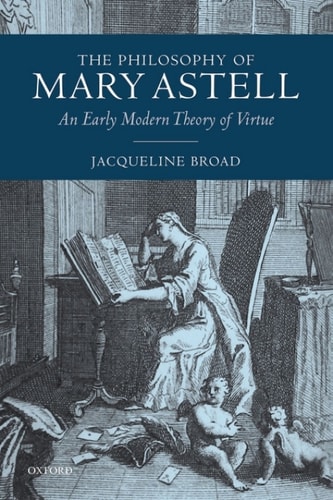
The Philosophy of Mary Astell: An Early Modern Theory of Virtue
0
0
As an Amazon Associate and affiliate partner, Menrva Books earns from qualifying purchases. Learn more
Author Description
Mary Astell (1666-1731) is best known today as one of the earliest English feminists. She is also known as a Tory political pamphleteer, an Anglican apologist, an eloquent rhetorician, and an educational theorist. In this book, Jacqueline Broad interprets Astell first and foremost as a moral philosopher, or as someone committed to providing guidance on how best to live and how to attain happiness. The central claim of this work is that all the different strands of Astell's thought--her theory of knowledge, her metaphysics, her philosophy of the passions, her feminist vision, and her conservative political views--are best understood in light of her ethical objectives. To demonstrate this, Broad examines Astell's major writings and traces her programme to bring about a moral transformation of character in her fellow women. This programme draws on several key aspects of seventeenth-century philosophy, including Cartesian and Neoplatonist epistemologies, proofs for the existence of God, arguments for the immaterial soul, and theories about how to regulate the passions in accordance with reason. At the heart of Astell's philosophy, it is argued, lies a theory of virtue and guidelines on how to cultivate generosity of character, a benevolent disposition toward other people, and the virtue of moderation. This book will help readers to see Astell's feminist, political, and religious views in the context of her wider philosophical vision. It provides a rich and illuminating account of a unique female-centred contribution to the philosophy of the early modern period. It will appeal to students and scholars in philosophy, history of ideas, and gender studies.
Menrva's Summary
THE THESIS
This book investigates whether Mary Astell’s diverse intellectual contributions—ranging from political pamphlets to educational theory—can be unified under the singular framework of moral philosophy. Jacqueline Broad, a scholar specializing in early modern philosophy, argues that Astell’s primary objective was to provide a coherent guide for attaining happiness and moral transformation. By analyzing Astell's writings through the lens of seventeenth-century Cartesian and Neoplatonist thought, Broad demonstrates that Astell’s feminist and political views are secondary to her overarching ethical project of cultivating virtue and reason.
THE SCOPE MAP
What You Will Find
- Analysis of Astell's theory of knowledge, metaphysics, and philosophy of the passions.
- Examination of seventeenth-century philosophical influences including Cartesianism and Neoplatonism.
- Discussion of Astell's specific ethical focus on generosity of character and moderation.
Scope Limits
- The text does not provide a comprehensive biography of Astell's personal life outside of her intellectual development.
- It does not offer a broad survey of all seventeenth-century female philosophers, focusing strictly on Astell's specific contributions.
THE AUTHORITY PERSPECTIVE
Scholars in the history of ideas recognize this work as a significant contribution to the re-evaluation of Mary Astell as a serious moral philosopher rather than solely a political figure. Readers frequently note the academic density of the prose, which is tailored for students and researchers in philosophy and gender studies.
Page Count:
224
Publication Date:
2015-01-01
Publisher:
OUP Oxford
ISBN-10:
0191026204
ISBN-13:
9780191026201
Philosophy
Ethics
Feminist Philosophy
Gender Studies
Early Modern
History of Ideas
Community Tags
Similar Books