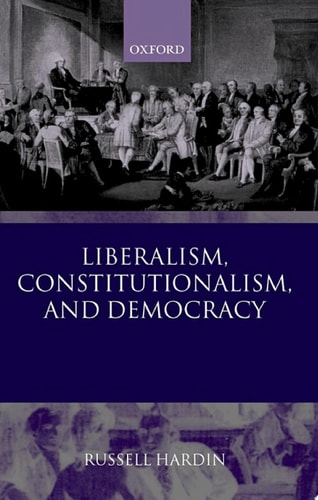
Liberalism, Constitutionalism, and Democracy
0
0
As an Amazon Associate and affiliate partner, Menrva Books earns from qualifying purchases. Learn more
Author Description
In his ground-breaking book, the leading political philosopher Russell Hardin develops a new theory of liberal constitutional democracy. Arguing against the standard consensus theories, the author shows how social co-ordination on limited, sociological mutual advantage lies at the heart of liberal constitutionalism when it works to produce stable government. The book argues that liberalism, constitutionalism, and democracy are co-ordination theories. They work only in societies in which co-ordination of the important power groups for mutual advantage is feasible. It then goes on to examine and interpret the US constitution as motivated centrally by the concern with creating a government to enable commerce. In addition, the book addresses the nature of the problems that the newly democratic, newly market-oriented states face. The analysis of constitutionalism is based on its workability, not on its intrinsic, normative, or universal appeals. Hardin argues, similarly, there are harsh limits on the possibilities of democracy. In general, democracy works only on the margins of great issues. Indeed, it is inherently a device for regulating marginal political conflicts.
Menrva's Summary
THE THESIS
This book investigates whether liberalism, constitutionalism, and democracy function primarily as mechanisms for social co-ordination rather than as universal normative ideals. Russell Hardin, a prominent political philosopher, utilizes a framework rooted in sociological mutual advantage to challenge standard consensus-based political theories. He argues that these systems are only effective when they facilitate co-ordination among powerful societal groups, specifically focusing on the practical workability of government structures.
THE SCOPE MAP
What You Will Find
- A theory of liberal constitutional democracy based on co-ordination.
- An interpretation of the United States Constitution as a tool for enabling commerce.
- Analysis of political challenges facing newly democratic and market-oriented states.
Scope Limits
- The text does not focus on the intrinsic, normative, or universal moral appeals of constitutionalism.
- It does not provide a comprehensive history of democratic theory, focusing instead on its functional limitations.
THE AUTHORITY PERSPECTIVE
Experts recognize this work as a rigorous, analytical contribution to political theory that prioritizes functional utility over traditional normative discourse. Readers frequently note the academic density of the prose and the author's uncompromising focus on the sociological constraints of political systems.
Page Count:
398
Publication Date:
2003-01-01
Publisher:
OUP Oxford
ISBN-10:
0191037400
ISBN-13:
9780191037405
Government
United States
Political Philosophy
Constitutional Law
Liberalism
Democracy
Community Tags
Other Editions(5)


Similar Books




Reader Comments
Share Your Thoughts
No comments yet. Be the first to share your thoughts!