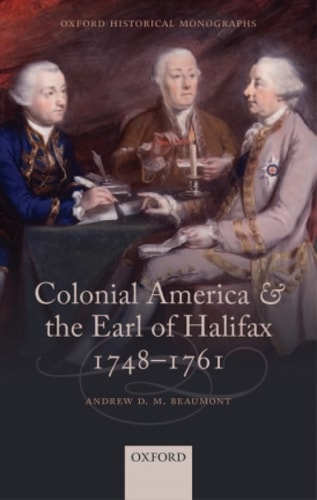
Colonial America and the Earl of Halifax, 1748-1761
0
0
As an Amazon Associate and affiliate partner, Menrva Books earns from qualifying purchases. Learn more
Author Description
Colonial America and the Earl of Halifax, 1748-1761 examines the governance of British America in the period prior to the American Revolution. Focusing upon the career of George Montagu Dunk, Second Earl of Halifax and First Lord of the Board of Trade & Plantations (1716-1771), it explores colonial planners and policy-makers during the political hiatus between the age of Walpole and the subsequent age of imperial crisis. As ambitious metropolitan politicians vied for ministerial dominance, Halifax's board played a vital role in shaping British perceptions of its growing empire. A repository of information and intelligence, the board offered Halifax the opportunity to establish his own niche interest, for the good of the empire and himself alike. Challenging the view that Britain's attitude towards its American colonies was one of ignorance compounded by complacency, this study explores those charged directly with governing America, from the imperial centre to its westward peripheries: the governors entrusted with maintaining the royal prerogative, and implementing reform. Between 1748 and 1761, Halifax sought to reform the America from a motley assortment of territories into an ordered, uniform asset of the imperial nation-state. Exploring the governors themselves reveals a complex, modern network of professional and personal loyalties, bound together through mutual self-interest under Halifax's leadership. Confronted by the Seven Years' War, Halifax saw his plans and followers dissipate in the face of global conflict, the results of which established British America, and also sowed the seeds of its eventual destruction in 1776. Long overshadowed by the acknowledged 'great men' of his age, this study restores Halifax and his interest to its rightful place as a significant influence upon major historical events, illustrating his grand, elaborate vision for an alternative British America that never was.
Menrva's Summary
THE THESIS
This study investigates how the governance of British America was shaped by the political ambitions and administrative reforms of George Montagu Dunk, the Second Earl of Halifax, between 1748 and 1761. Andrew D. M. Beaumont, a historian specializing in 18th-century imperial administration, utilizes archival records from the Board of Trade and Plantations to challenge the narrative of British colonial neglect. He argues that Halifax attempted to transform the American colonies into a structured, uniform asset of the British state, creating a network of loyalists and administrators that functioned until the disruptions of the Seven Years' War.
THE SCOPE MAP
What You Will Find
- Analysis of the Board of Trade and Plantations' administrative functions.
- Examination of the political career of George Montagu Dunk, Second Earl of Halifax.
- Investigation into the professional and personal networks of colonial governors.
- Contextualization of British imperial policy during the mid-18th century.
Scope Limits
- The study concludes in 1761 and does not provide a detailed account of the immediate lead-up to the 1776 revolution.
- The focus remains primarily on metropolitan policy-makers and high-level colonial administrators rather than the experiences of the general colonial population.
THE AUTHORITY PERSPECTIVE
Scholars recognize this work as a significant contribution to the study of British imperial administration, noting its success in moving beyond the traditional 'salutary neglect' thesis. Readers frequently highlight the academic density of the prose, which is tailored for researchers and students of 18th-century political history.
Page Count:
288
Publication Date:
2014-01-01
Publisher:
OUP Oxford
ISBN-10:
0191035874
ISBN-13:
9780191035876
History
British History
Imperialism
18th century
European History
Political History
America history
Community Tags
Similar Books