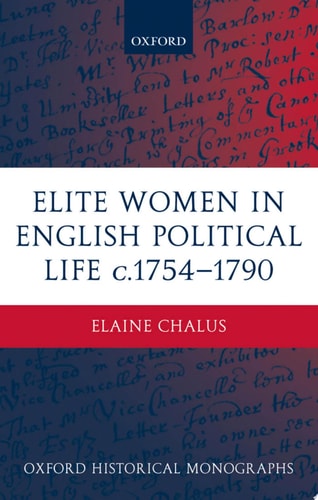
Elite Women in English Political Life c.1754-1790
0
0
As an Amazon Associate and affiliate partner, Menrva Books earns from qualifying purchases. Learn more
Author Description
Based on wide-ranging, original research into political, personal, and general correspondences across a period of significant social and political change, this book explores the gendered nature of politics and political life in eighteenth-century England by focusing on the political involvement of female members of the political elite. Elaine Chalus challenges the notion that only exceptional women were involved in politics, that their participation was necessarily limited and indirect, and that their involvement was inevitably declining after the 1784 Westminster Election. While exceptional women did exist and gender did condition women's participation, the personal, social, and particularly the familial nature of eighteenth-century politics provided more women with a wider variety of opportunities for involvement than ever before. Women from politically active families grew up with politics, absorbing its rituals, and their own involvement extended from politicized socializing up to borough control and election management. Their participation was often accepted, expected, or even demanded, depending upon family traditions, personal abilities, and the demands of political expediency. Chalus reveals that, although women's involvement in political life was always potentially more problematic than men's, given contemporary concerns about the links between sex, politics, and corruption, their participation was largely unproblematic as long as their activities could be explained by recourse to a familial model which depicted their participation as subordinate and supportive of men's. It was when they came to be seen as the leading political actors in a cause that they overstepped the mark and became targets of sexualized criticism. Contemporary critics worried that politically active women posed a threat to male polity, but what actually made them threatening was that they proved that women were not politically incompetent and implicitly demonstrated that gender was not
Menrva's Summary
THE THESIS
This work investigates the extent and nature of female political participation within the English elite during the latter half of the eighteenth century. Elaine Chalus, a historian specializing in the period, utilizes an extensive collection of personal and political correspondence to challenge traditional historiography. She argues that political involvement for elite women was not merely exceptional or indirect, but rather a normalized, familial activity that evolved alongside the shifting political landscape of the era.
THE SCOPE MAP
What You Will Find
- Analysis of political correspondence and personal records from 1754 to 1790
- Examination of the familial model of political engagement
- Case studies on election management and borough control
- Discussion of the gendered reception of female political actors
Scope Limits
- Does not cover the political activities of women outside the aristocratic and landed elite
- Does not extend analysis beyond the 1790 timeframe
THE AUTHORITY PERSPECTIVE
Scholars recognize this monograph as a significant contribution to the study of eighteenth-century political culture and gender roles. Readers frequently note the academic density of the prose and the depth of the archival research presented by the author.
Page Count:
286
Publication Date:
2005-01-01
Publisher:
Clarendon Press
ISBN-10:
0191535605
ISBN-13:
9780191535604
History
Women ireland
Politics & Government
Womens History
Political History
Gender Studies
British History
18th century
European History
Community Tags
Other Editions(2)
Similar Books
Reader Comments
Share Your Thoughts
No comments yet. Be the first to share your thoughts!