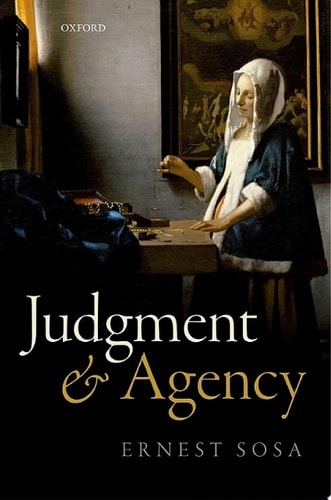
Judgment and Agency
0
0
As an Amazon Associate and affiliate partner, Menrva Books earns from qualifying purchases. Learn more
Author Description
Ernest Sosa extends his distinctive approach to epistemology, intertwining issues concerning the role of the will in judgment and belief with issues of epistemic evaluation. Questions about skepticism and the nature of knowledge are at the forefront. The answers defended are new in their explicit and sustained focus on judgment and epistemic agency. While noting that human knowledge trades on distinctive psychological capacities, Sosa also emphasizes the role of the social in human knowledge. Basic animal knowledge is supplemented by a level of reflective knowledge focused on judgment, and a level of 'knowing full well' that is distinctive of the animal that is rational.
Menrva's Summary
THE THESIS
This work investigates the intersection of human agency and epistemic evaluation, specifically questioning how the will influences the formation of judgment and belief. Ernest Sosa, a prominent figure in contemporary epistemology, utilizes his virtue epistemology framework to argue that knowledge is not merely a passive state but an active, agency-driven achievement. He posits that human knowledge functions across distinct levels, ranging from basic animal cognition to reflective, rational judgment.
THE SCOPE MAP
What You Will Find
- A comprehensive framework for virtue epistemology
- Analysis of the distinction between animal knowledge and reflective knowledge
- Exploration of the social dimensions of human cognition
- Examination of skepticism and the nature of epistemic justification
Scope Limits
- The text does not provide a historical survey of all epistemological schools
- It does not focus on empirical psychological data or neuroscientific evidence
THE AUTHORITY PERSPECTIVE
Experts recognize this text as a significant contribution to the development of virtue epistemology, particularly regarding the role of the agent in knowledge acquisition. Readers frequently note the academic density of the prose, which is intended for an audience familiar with analytic philosophy.
Page Count:
269
Publication Date:
2015-01-01
Publisher:
OUP Oxford
ISBN-10:
0191030430
ISBN-13:
9780191030437
Philosophy
Judgment
Metaphysics
Logic
Epistemology
Community Tags
Similar Books