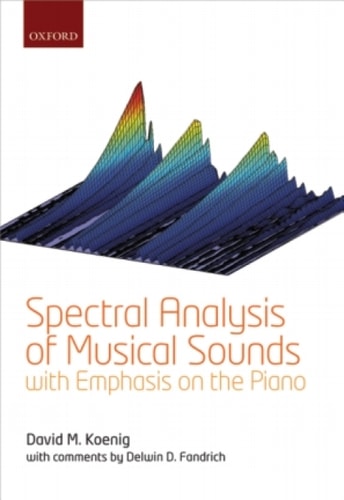
Spectral Analysis of Musical Sounds with Emphasis on the Piano
0
0
As an Amazon Associate and affiliate partner, Menrva Books earns from qualifying purchases. Learn more
Author Description
This book addresses the analysis of musical sounds from the viewpoint of someone at the intersection between physicists, engineers, piano technicians, and musicians. The study is structured into three parts. The reader is introduced to a variety of waves and a variety of ways of presenting, visualizing, and analyzing them in the first part. A tutorial on the tools used throughout the book accompanies this introduction. The mathematics behind the tools is left to the appendices. Part Two provides a graphical survey of the classical areas of acoustics that pertain to musical instruments: vibrating strings, bars, membranes, and plates. Part Three is devoted almost exclusively to the piano. Several two- and three-dimensional graphical tools are introduced to study various characteristics of pianos: individual notes and interactions among them, the missing fundamental, inharmonicity, tuning visualization, the different distribution of harmonic power for the various zones of the piano keyboard, and potential uses for quality control. These techniques are also briefly applied to other musical instruments studied in earlier parts of the book. For physicists and engineers there are appendices to cover the mathematics lurking beneath the numerous graphs and a brief introduction to Matlab® which was used to generate these graphs. A website accompanying the book (https://sites.google.com/site/analysisofsoundsandvibrations/) contains: - Matlab® scripts - mp3 files of sounds - references to YouTube videos - and up-to-date results of recent studies
Menrva's Summary
THE THESIS
This book investigates the intersection of physics, engineering, and musical acoustics, specifically focusing on the spectral analysis of piano sounds. The author, David M. Koenig, provides a technical framework for visualizing and analyzing sound waves, bridging the gap between theoretical acoustics and practical piano technology. By utilizing graphical tools and Matlab-based analysis, the text aims to demystify the complex harmonic structures of musical instruments for both technical professionals and musicians.
THE SCOPE MAP
What You Will Find
- Graphical surveys of vibrating strings, bars, membranes, and plates.
- Analysis of piano-specific phenomena including inharmonicity and the missing fundamental.
- Tutorials on visualization tools and Matlab scripts for sound analysis.
- Comparative studies of harmonic power distribution across the piano keyboard.
Scope Limits
- The text does not provide an exhaustive mathematical derivation within the main chapters, relegating complex proofs to the appendices.
- The analysis is focused primarily on the piano, with only brief applications of the methodology to other musical instruments.
THE AUTHORITY PERSPECTIVE
Experts and practitioners in piano technology frequently cite this work as a valuable resource for its accessible graphical approach to complex acoustic data. Readers often note that while the prose is approachable for musicians, the inclusion of technical appendices makes it a robust reference for engineers and physicists.
Page Count:
336
Publication Date:
2014-01-01
Publisher:
OUP Oxford
ISBN-10:
0191034436
ISBN-13:
9780191034435
Earth Sciences
Physics
Music Technology
Acoustics
Piano
Engineering
Community Tags
Similar Books