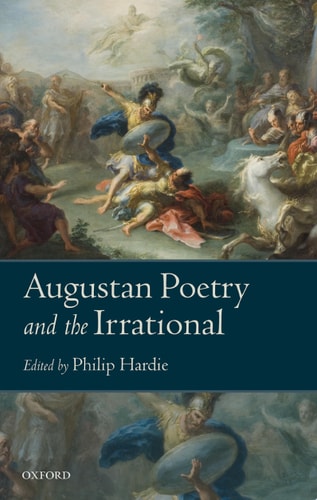
Augustan Poetry and the Irrational
0
0
As an Amazon Associate and affiliate partner, Menrva Books earns from qualifying purchases. Learn more
Author Description
The establishment of the Augustan regime presents itself as the assertion of order and rationality in the political, ideological, and artistic spheres, after the disorder and madness of the civil wars of the late Republic. But the classical, Apollonian poetry of the Augustan period is fascinated by the irrational in both the public and private spheres. There is a vivid memory of the political and military furor that destroyed the Republic, and also an anxiety that furor may resurface, that the repressed may return. Epic and elegy are both obsessed with erotic madness: Dido experiences in her very public role the disabling effects of love that are both lamented and celebrated by the love elegists. Didactic (especially the Georgics) and the related Horatian exercises in satire and epistle, offer programmes for constructing rational order in the natural, political, and psychological worlds, but at best contain uneasily an ever-present threat of confusion and backsliding, and for the most part fall short of the austere standards of rational exposition set by Lucretius. Dionysus and the Dionysiac enjoy a prominence in Augustan poetry and art that goes well beyond the merely ornamental. The person of the emperor Augustus himself tests the limits of rational categorization. Augustan Poetry and the Irrational contains contributions by some of the leading experts of the Augustan period as well as a number of younger scholars. An introduction which surveys the field as a whole is followed by chapters that examine the manifestations of the irrational in a range of Augustan poets, including Virgil, Horace, Ovid, and the love elegists, and also explore elements of post-classical reception.
Menrva's Summary
THE THESIS
This volume investigates the tension between the perceived rational order of the Augustan regime and the persistent presence of the irrational within the period's canonical poetry. Philip Hardie, a distinguished scholar of Latin literature, compiles a series of essays that analyze how Augustan poets—including Virgil, Horace, and Ovid—grappled with the legacy of civil war, erotic madness, and the inherent instability of political and psychological structures. The contributors argue that the Apollonian facade of the era often masked a profound anxiety regarding the return of repressed chaos.
THE SCOPE MAP
What You Will Find
- Analysis of epic, elegy, didactic poetry, and satire from the Augustan period.
- Examination of Dionysiac imagery and its role in challenging rational categorization.
- Comparative studies between Augustan works and the philosophical framework of Lucretius.
Scope Limits
- The text focuses primarily on literary manifestations of the irrational rather than a comprehensive political history of the Augustan regime.
- It does not provide an exhaustive survey of all minor poets of the era, concentrating instead on major canonical figures and specific thematic threads.
THE AUTHORITY PERSPECTIVE
Scholars and students of classical literature frequently cite this collection as a significant contribution to understanding the psychological undercurrents of Roman poetry. The text is noted for its academic rigor and is considered a valuable resource for those examining the intersection of political ideology and artistic expression in antiquity.
Page Count:
336
Publication Date:
2016-01-01
Publisher:
OUP Oxford
ISBN-10:
0191037710
ISBN-13:
9780191037719
Poetry
Augustan Age
Latin poetry
English
English & College Success
Academic
Roman History
Literary Criticism
Community Tags
Similar Books