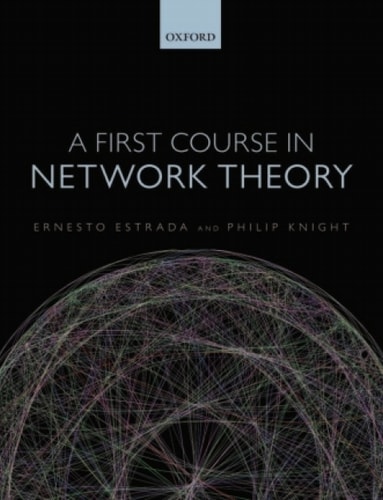
A First Course in Network Theory
0
0
As an Amazon Associate and affiliate partner, Menrva Books earns from qualifying purchases. Learn more
Author Description
The study of network theory is a highly interdisciplinary field, which has emerged as a major topic of interest in various disciplines ranging from physics and mathematics, to biology and sociology. This book promotes the diverse nature of the study of complex networks by balancing the needs of students from very different backgrounds. It references the most commonly used concepts in network theory, provides examples of their applications in solving practical problems, and clear indications on how to analyse their results. In the first part of the book, students and researchers will discover the quantitative and analytical tools necessary to work with complex networks, including the most basic concepts in network and graph theory, linear and matrix algebra, as well as the physical concepts most frequently used for studying networks. They will also find instruction on some key skills such as how to proof analytic results and how to manipulate empirical network data. The bulk of the text is focused on instructing readers on the most useful tools for modern practitioners of network theory. These include degree distributions, random networks, network fragments, centrality measures, clusters and communities, communicability, and local and global properties of networks. The combination of theory, example and method that are presented in this text, should ready the student to conduct their own analysis of networks with confidence and allow teachers to select appropriate examples and problems to teach this subject in the classroom.
Menrva's Summary
THE THESIS
This text investigates the fundamental mathematical and analytical frameworks required to understand, model, and interpret complex networks across diverse scientific disciplines. The authors, Ernesto Estrada and Philip A. Knight, leverage their expertise in mathematical physics and computational science to provide a structured introduction to network theory. By synthesizing graph theory, linear algebra, and statistical mechanics, they establish a rigorous methodology for students and researchers to analyze empirical network data and derive meaningful physical insights.
THE SCOPE MAP
What You Will Find
- Foundational concepts in graph theory and matrix algebra
- Quantitative tools for analyzing network fragments and centrality measures
- Methodologies for calculating degree distributions and communicability
- Practical applications for modeling random networks and community structures
Scope Limits
- Advanced specialized topics in dynamic network evolution
- Extensive historical background of graph theory development
- Software-specific coding tutorials or implementation guides
THE AUTHORITY PERSPECTIVE
Experts and educators frequently cite this text as a balanced, accessible entry point for students transitioning into network science from varied quantitative backgrounds. Readers often note the clarity of the prose and the effective integration of theoretical proofs with practical analytical applications.
Page Count:
272
Publication Date:
2015-01-01
Publisher:
OUP Oxford
ISBN-10:
0191039926
ISBN-13:
9780191039928
Mathematical Physics
Mathematics
Network Theory
Computer Science
Academic Textbooks
Physics
Graph Theory
Earth Sciences
Community Tags
Similar Books