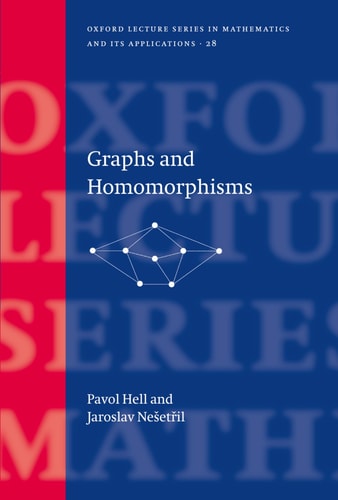
Graphs and Homomorphisms
0
0
As an Amazon Associate and affiliate partner, Menrva Books earns from qualifying purchases. Learn more
Author Description
This is a book about graph homomorphisms. Graph theory is now an established discipline but the study of graph homomorphisms has only recently begun to gain wide acceptance and interest. The subject gives a useful perspective in areas such as graph reconstruction, products, fractional and circular colourings, and has applications in complexity theory, artificial intelligence, telecommunication, and, most recently, statistical physics. Based on the authors' lecture notes for graduate courses, this book can be used as a textbook for a second course in graph theory at 4th year or master's level and has been used for courses at Simon Fraser University (Vancouver), Charles University (Prague), ETH (Zurich), and UFRJ (Rio de Janeiro). The exercises vary in difficulty. The first few are usually intended to give the reader an opportunity to practice the concepts introduced in the chapter; the later ones explore related concepts, or even introduce new ones. For the harder exercises hints and references are provided. The authors are well known for their research in this area and the book will be invaluable to graduate students and researchers alike.
Menrva's Summary
THE THESIS
This book investigates the mathematical framework and applications of graph homomorphisms within the broader field of graph theory. The authors, Jaroslav Nesetril and Pavol Hell, draw upon their extensive research backgrounds and lecture notes from international institutions to synthesize the current state of the field. They present a structured approach to understanding how homomorphisms function as a tool for analyzing graph reconstruction, coloring problems, and various computational complexities.
THE SCOPE MAP
What You Will Find
- Theoretical foundations of graph homomorphisms
- Applications in complexity theory, artificial intelligence, and statistical physics
- Advanced topics including fractional and circular colorings
- A collection of graded exercises with hints and references
Scope Limits
- The text assumes a prior foundational knowledge of graph theory
- It does not cover introductory graph theory concepts for undergraduate beginners
THE AUTHORITY PERSPECTIVE
Experts recognize this work as a foundational text for graduate-level study in graph theory and its computational applications. Readers frequently note the academic density of the prose, which serves as a rigorous resource for both students and active researchers in the field.
Page Count:
256
Publication Date:
2004-01-01
Publisher:
OUP Oxford
ISBN-10:
0191523720
ISBN-13:
9780191523724
Complexity Theory
Post-Calculus
Graph Theory
Academic Textbooks
Mathematics Statistics
Computer Science
Mathematics