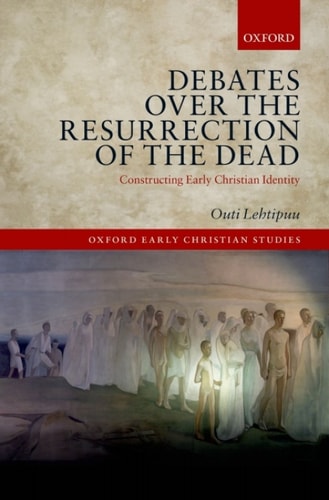
Debates over the Resurrection of the Dead: Constructing Early Christian Identity
0
0
As an Amazon Associate and affiliate partner, Menrva Books earns from qualifying purchases. Learn more
Author Description
In Debates over the Resurrection of the Dead, Outi Lehtipuu highlights the striking observation that in many early texts the way that belief in resurrection is formulated is used as a sign of inclusion and exclusion, not only in relation to non-Christians but vis-à-vis other Christians. Those who teach otherwise have deviated from the truth, are not true Christians, and do the works of the devil. Using insights from the sociological study of deviance, Dr Lehtipuu demonstrates that labelling was used as a tool for marking boundaries between those who belonged and those who did not. This was extremely important in the fluid conditions where the small Christian minority groups found themselves. In a situation where there were no universally accepted structures that defined what constituted the true Christian belief, several competing interpretations and their representatives struggled for recognition of their views based on what they believed to be the apostolic tradition. The most hotly-debated aspect of resurrection was whether it would entail the body of flesh and blood or not. When resurrection would take place was closely related to this. Controversies died since the scriptural legacy was ambiguous enough to allow different hermeneutical solutions. The battle over resurrection was closely related to the question of how scriptures were to be understood as well as to what constituted the human self that would survive death. To demonstrate this a wide variety of texts are studied, from theological treatises (including relevant Nag Hammadi texts) to apocryphal acts and martyrologies. Acknowledging the complexity and diversity of the early Christian movement, this volume views early Christian discourse as part of the broader ancient discursive world where similar debates were going on among both Jews and the majority population.
Menrva's Summary
THE THESIS
This work investigates how early Christian debates regarding the resurrection of the dead functioned as a mechanism for constructing group identity and defining theological boundaries. Outi Lehtipuu, a scholar of early Christian history, utilizes sociological theories of deviance to analyze how competing factions within the early church used resurrection doctrine to label opponents and solidify their own legitimacy. By examining the ambiguity of scriptural interpretation, the author argues that these debates were not merely abstract theological disagreements but essential tools for social cohesion and exclusion in a diverse, unorganized religious movement.
THE SCOPE MAP
What You Will Find
- Analysis of early Christian theological treatises, apocryphal acts, and martyrologies
- Application of sociological deviance theory to ancient religious discourse
- Examination of the Nag Hammadi texts in the context of resurrection debates
- Comparative analysis of Jewish and broader ancient Mediterranean discursive practices
Scope Limits
- The study does not provide a comprehensive history of all early Christian doctrines
- It does not focus on the later institutionalization of the church after the fourth century
THE AUTHORITY PERSPECTIVE
Scholars recognize this text as a rigorous contribution to the study of early Christian identity formation and social boundary marking. Readers frequently note the academic density of the prose, which makes it a specialized resource for historians and theologians interested in the diversity of the early church.
Page Count:
256
Publication Date:
2015-01-01
Publisher:
OUP Oxford
ISBN-10:
0191037788
ISBN-13:
9780191037788
Religion
History
Church History
Christianity
Sociology of Religion
Theology
Resurrection
Community Tags
Similar Books