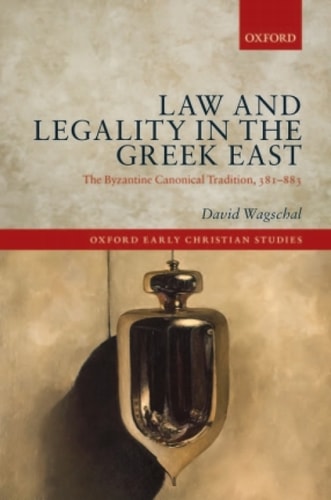
Law and Legality in the Greek East: The Byzantine Canonical Tradition, 381-883
0
0
As an Amazon Associate and affiliate partner, Menrva Books earns from qualifying purchases. Learn more
Author Description
Byzantine church law remains terra incognita to most scholars in the western academy. In this work, David Wagschal provides a fresh examination of this neglected but fascinating world. Confronting the traditional narratives of decline and primitivism that have long discouraged study of the subject, Wagschal argues that a close reading of the central monuments of Byzantine canon law c. 381-883 reveals a much more sophisticated and coherent legal culture than is generally assumed. Engaging in innovative examinations of the physical shape and growth of the canonical corpus, the content of the canonical prologues, the discursive strategies of the canons, and the nature of the earliest forays into systematization, Wagschal invites his readers to reassess their own legal-cultural assumptions as he advances an innovative methodology for understanding this ancient law. Law and Legality in the Greek East explores topics such as compilation, jurisprudence, professionalization, definitions of law, the language of the canons, and the relationship between the civil and ecclesiastical laws. It challenges conventional assumptions about Byzantine law while suggesting many new avenues of research in both late antique and early medieval law, secular and ecclesiastical.
Menrva's Summary
THE THESIS
This work investigates the sophistication and coherence of Byzantine canon law between 381 and 883, challenging long-standing academic narratives of decline and primitivism. David Wagschal, a scholar of early Christian and Byzantine legal traditions, utilizes a close reading of canonical corpora and prologues to argue that the Byzantine legal culture was far more structured than previously acknowledged. By analyzing the evolution of legal discourse and the systematization of ecclesiastical rules, the author provides a framework for re-evaluating the relationship between civil and religious authority in the Greek East.
THE SCOPE MAP
What You Will Find
- Analysis of the canonical corpus from 381 to 883
- Examination of canonical prologues and discursive strategies
- Investigation into the professionalization of legal practice
- Comparative study of civil and ecclesiastical legal frameworks
Scope Limits
- The study focuses primarily on the Greek East and does not provide an exhaustive history of Western canon law
- The research is limited to the period ending in 883 and does not cover later Byzantine legal developments
THE AUTHORITY PERSPECTIVE
Scholars recognize this text as a significant intervention in the study of Byzantine legal history, particularly for its rejection of traditional decline narratives. Experts frequently note the academic density of the prose, marking it as a specialized resource for historians and legal scholars interested in late antiquity.
Page Count:
352
Publication Date:
2014-01-01
Publisher:
OUP Oxford
ISBN-10:
0191034177
ISBN-13:
9780191034176
History
Religion
Byzantine History
Legal History
Law Byzantine
Canon law
Community Tags
Similar Books